 |
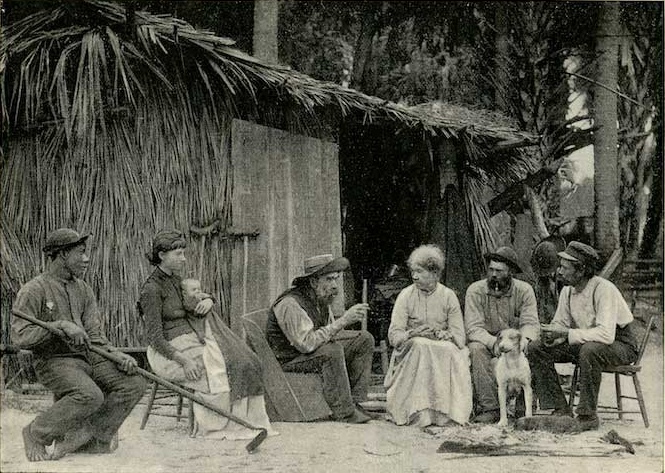
| Florida residents sit with their guests in front of their homestead's main structure. This photo is from an 1892 issue of Demorest's Magazine. |
By the 1890s, Florida's cities offered growing lists of amenities that eased daily life for residents. Not so for people who lived far from urban centers. Some Florida Crackers deep in the backwoods had primitive living arrangements.
One of the clearest examples of this, that I've come across, is an 1892 article written by archeologist Clarence Bloomfield Moore for Demorest's Family Magazine. Moore made yearly trips to Florida for sport activities or to conduct antiquities research. Each year he stopped to visit a Cracker friend who lived on the shores of Lake Harney in the east central part of the state. The1892 article is about one of these visits.
You can read the magazine article on the Florida Memory website. My focus in this post is on the living conditions of a family identified only as Captain Mansfield, his "old woman" (no name or relationship provided), a hired worker named Grant and an unnamed young woman with a baby. The young mother was introduced as a relative of the Captain's.
The Mansfield homestead consisted of the following:
- a one-room cabin made of palmetto thatch, with a palmetto lean-to attached to the back;
- a palmetto-roofed barn with a loft and with walls made of animal skins;
- an outdoor, open-air kitchen that had a roof, if you can call it that. You can see what I mean in the photo at the end of this post.
Moore said the assembled group lived contentedly on the lakeshore in this ramshackle collection of buildings. Mansfield and the older woman slept in the one-room cabin, the younger woman and the baby resided in the lean-to and the hired worker slept in the barn loft.
If you look at the group photo, everyone does seem somewhat laid-back as they listen to the Captain tell stories of Seminole War days. He was a Civil War veteran as well as a Seminole War veteran. To me, he doesn't look old enough to have fought in any but the third of the Seminole Wars. But looks can deceive. The "old woman" appears quite aged in a close-up photo you'll see if you read the article.
In Moore's story, the Captain and the older woman come across as likeable, talkative and welcoming to their visitors. Moore and/or his traveling companions (not sure who's who among the visitors) seem equally at home in the photo, accepted even by one of the guard dogs who initially greeted the Northerners with bared teeth. The young woman and hired worker don't have voices in the story but are included in the group photo.
Neighbors were nonexistent. Moore says the homestead was the only habitation around the entire lake, a nine-mile body of water with 11 miles of shoreline. The nearest thing to a settlement was a small community named Geneva, three miles away. Even today, Geneva's population is less than 3,000 people.
I can't even begin to understand the work required just to survive -- just to make sure there was enough food, water and shelter to sustain life on the homestead. I can't imagine cooking in what passed for a kitchen. Or sleeping surrounded by palmetto fronds that harbored all kinds of insects. How did the family ride out storms and deal with year-round mosquitos? What happened if they became ill? To say this family lived close to nature is an understatement.
I also want to know more about the relationships among what, at first glance, appears to be a mismatched assortment of people. Ones who looked out for each other in wild surroundings. Who heard bird call in the morning and saw star-studded skies at night. Who shared a hard life with a seeming contentment that escapes so many in our modern age.
 |
| This photo of a Florida homesteader in her kitchen is from an 1892 issue of Demorest's Magazine. |


