Saturday, October 28, 2023

Backwoods life, no filter

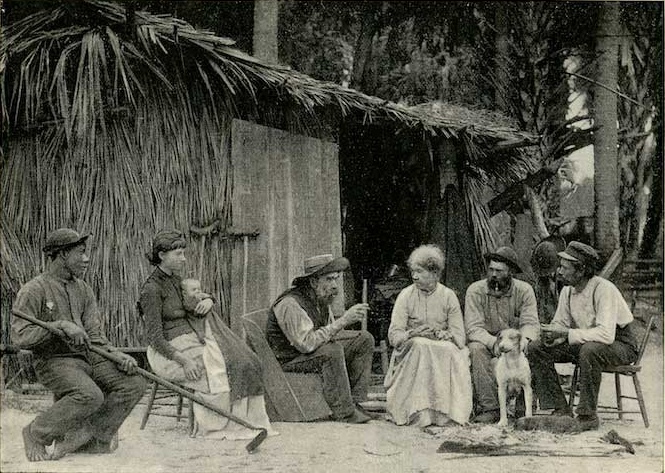
Group seated in front of palmetto cabin in 1890s
Florida residents sit with their guests in front of their
homestead's main structure. This photo is from an 
1892 issue of Demorest's Magazine.

By the 1890s, Florida's cities offered growing lists of amenities that eased daily life for residents. Not so for people who lived far from urban centers. Some Florida Crackers deep in the backwoods had primitive living arrangements. 

One of the clearest examples of this, that I've come across, is an 1892 article written by archeologist Clarence Bloomfield Moore for Demorest's Family Magazine. Moore made yearly trips to Florida for sport activities or to conduct antiquities research. Each year he stopped to visit a Cracker friend who lived on the shores of Lake Harney in the east central part of the state. The1892 article is about one of these visits.

You can read the magazine article on the Florida Memory website. My focus in this post is on the living conditions of a family identified only as Captain Mansfield, his "old woman" (no name or relationship provided), a hired worker named Grant and an unnamed young woman with a baby. The young mother was introduced as a relative of the Captain's.

The Mansfield homestead consisted of the following:

  • a one-room cabin made of palmetto thatch, with a palmetto lean-to attached to the back;
  • a palmetto-roofed barn with a loft and with walls made of animal skins;
  • an outdoor, open-air kitchen that had a roof, if you can call it that. You can see what I mean in the photo at the end of this post. 

Moore said the assembled group lived contentedly on the lakeshore in this ramshackle collection of buildings. Mansfield and the older woman slept in the one-room cabin, the younger woman and the baby resided in the lean-to and the hired worker slept in the barn loft. 

If you look at the group photo, everyone does seem somewhat laid-back as they listen to the Captain tell stories of Seminole War days. He was a Civil War veteran as well as a Seminole War veteran. To me, he doesn't look old enough to have fought in any but the third of the Seminole Wars. But looks can deceive. The "old woman" appears quite aged in a close-up photo you'll see if you read the article.

In Moore's story, the Captain and the older woman come across as likeable, talkative and welcoming to their visitors. Moore and/or his traveling companions (not sure who's who among the visitors) seem equally at home in the photo, accepted even by one of the guard dogs who initially greeted the Northerners with bared teeth. The young woman and hired worker don't have voices in the story but are included in the group photo.

Neighbors were nonexistent. Moore says the homestead was the only habitation around the entire lake, a nine-mile body of water with 11 miles of shoreline. The nearest thing to a settlement was a small community named Geneva, three miles away. Even today, Geneva's population is less than 3,000 people.

I can't even begin to understand the work required just to survive -- just to make sure there was enough food, water and shelter to sustain life on the homestead. I can't imagine cooking in what passed for a kitchen. Or sleeping surrounded by palmetto fronds that harbored all kinds of insects. How did the family ride out storms and deal with year-round mosquitos? What happened if they became ill? To say this family lived close to nature is an understatement.

I also want to know more about the relationships among what, at first glance, appears to be a mismatched assortment of people. Ones who looked out for each other in wild surroundings. Who heard bird call in the morning and saw star-studded skies at night. Who shared a hard life with a seeming contentment that escapes so many in our modern age. 

photo of woman standing in very rustic outdoor kitchen
This photo of a Florida homesteader
 in her kitchen is from an 1892 issue
of Demorest's Magazine.


Thursday, September 28, 2023

Read between lines

small section of an 1879 newspaper article
Regional fairs were popular events in 
pioneer Florida. (Gerri Bauer photo)

About 260,000 people lived in Florida in 1879. They rattled around in the state's 67,760 square miles. For comparison, the state's current population is about 22 million -- 22,000,000 versus 260,000. 

The state in 1879 was basically empty. Regional social or other events were limited. People were more focused on survival. And intrastate travel was challenging and time-consuming.

But residents flocked to gatherings that did take place and made the most of them. That's clear in an 1879 Florida Agriculturist newspaper article about that year's Central Florida Fair. Which, for some reason, took place in Tallahassee in northern Florida.

I don't know about fairs where you live, but in my area entries into the county fair food division have dwindled over the years. They're almost down to nothing. Imagine my surprise when I read that Mrs. W.H. Gibson entered "355 articles, all prepared by the same lady" at the 1879 fair. Her entries included 117 types of preserves and 82 varieties of jelly. 

Even weirder is how one item, a jar of watermelon citron preserves, was noted to be 25 years old. Did competitors save their items and enter them year after year in one giant pile? They must have. Because Mrs. Gibson wasn't an outlier.

Mrs. W.H. Scott entered 220 kinds of jellies, preserves, syrups, marmalades and other items. Mrs. T.J. Young bemoaned how she only had 116 varieties to enter because several jars broke during her journey to Tallahassee from Thomasville, Georgia. Other things were too difficult to transport. I wonder what they were. Among the items that did make it were an intricately carved and preserved watermelon rind basket and seven kinds of wine.

The fresh fruit and vegetable divisions were also popular categories. In these areas, people seemed to enter a lesser number of goods per person. Several outstanding competitors, most of them men, were listed by name and type of entry or entries.

This was a time when members of local black populations often weren't dignified by given name in or out of print. I was glad to read that, "Three very large and fine pumpkins were put on exhibition by Becky Pope, a colored woman of this county."

Not sure why there was a need to mention race. But it was a very different time, almost 150 years distant from our 21st century eyes. I credit the reporter for including Becky's name and the editors for keeping it in the story. Their actions gave her an identity and preserved it through time. 

Read between the lines, though. The precise wording could have constituted a slight snub or simply an acceptance of local tradition. Becky's name is presented in a less-respectful way than dictated by the era's formal naming conventions. The women who entered all the preserves were each identified by their husband's initials. That's how married women were named in public and in print at that time and into the 20th century. Names of unmarried, presumably white, competitors at the 1879 fair were given in full and preceded by the title Miss. 

We don't know if Becky was single or married, but we do know her full name. That's more than we can say for the married women whose preserves and jellies were entered under their husbands' names. We don't know anything personal at all about the lady who entered 355 items except that her husband's name was W.H. Gibson.

All in all, I was intrigued to see the acknowledgement of black competitors in print only two years after Reconstruction ended. Another part of the article reported that "Several loaves of light bread and other articles in this department were entered by colored women for prizes, against their fairer competitors."

The use of the word "fairer" instead of "white" could have been an intended slight against the black women. Or not. Maybe that was the only way the reporter was able to mention the black women's entries and get it past the editors. Ditto for how Becky Pope was named. I'm a retired journalist. I know how the profession operates  - or operated decades ago, anyway. I don't consider today's bias-driven news to be real journalism.

Back to the fair. No word on who won the bread competition, although all entries were deemed "very creditable." The reporter mentioned that an awards list was issued separately by the fair.

The article goes on and on, listing numerous people - primarily men - and their entries of fruits, vegetables, grains and livestock. The fair must have been a fairly recent initiative, because it was proclaimed a "complete success" and everyone believed it had a bright future. I wish the future of race relations had proved as promising. And I wish I knew the given names of those ladies who produced such marvelous preserves.

Tuesday, August 29, 2023

A tug, a grunt, and a hope for the best

Exterior of Central Florida Railroad Museum building
Central Florida Railroad Museum 
(Gerri Bauer photo)

I love train travel. And sometimes I project the idea of today's comfortable rides onto the conditions available in Florida's pioneer years. Early settlers would have a good laugh at that. 

Trains rolled over the steamboat industry in the late 1800s and early 1900s in Florida. Those early rides were no picnics. That came clear to me on a recent visit to the Central Florida Railroad Museum in Winter Garden. The city is part of the Orlando metro area but has a beautiful and walkable downtown historic district.

The railroad museum is well worth a visit. I particularly liked the displays of different railroad lines' cutlery and dishware. Those kind of details bring home for me the day-to-day living in a specific time. The dishware, as you can imagine, was thick, sturdy stoneware. Some was decorated simply but others featured elaborate floral designs. The collection is varied and includes examples from a wide range of railroad lines including Amtrak.

But the first short-line, early trains to pass through the state weren't serving dinner. They primarily transported citrus, although people used them too. There was nothing fancy about these railroads. That's depicted clearly in the numerous photographs of rail cars, equipment, depots and more on display at the museum. Equipment used through the years is also on view and there's a model train display.

The museum is housed in the former depot of the now-defunct Tavares & Gulf Railroad, which operated along a 32-mile track with a 6-mile branch. Established in the 1880s, the railroad was sold in the 1920s and made its last run in 1969.

I'm most interested in its early years during the pioneer era. Museum literature and displays say the railroad, in those days, was better known locally as Tug & Grunt instead of Tavares & Gulf. That's because it kept derailing. In 1905, it held a national record for jumping the track nine times in a single round trip. I can only imagine the effort required to push a rail car back into line. 

Yes, early train travel was definitely an adventure. Certainly nothing like the relaxing comfort of today's rides. For that, I'm glad. I love learning about the past but the older I get, the happier I am to have modern comforts.

Photo of a photo on display in the railroad museum
Museum photo, above, shows a derailed train,
something that happened frequently on this
particular rail line. Below is an example
of the dishware displays at the museum.
(Gerri Bauer photos)

Photo of dishware used by railroads

Saturday, July 29, 2023

All those miles of canals

Cape Coral began as a dream.
(Screengrab credit WGCU Public Media)

You have to wonder, what if? What if Cape Coral's developers hadn't done so much dredging almost 70 years ago? Hadn't created so many canals so everyone in the planned community could have a waterfront home? Hadn't inadvertently made conditions perfect for Hurricane Ian.

The 2022 storm's 140 mph winds and surging waters slammed Cape Coral. Canals overflowed, boats and buildings and businesses were destroyed.

The questions popped into mind when I watched a 2006 video about Cape Coral's creation. As with other Florida planned communities, the city in southwest Florida started as a dream. Brothers Jack and Leonard Rosen bought about 115 square miles on a peninsula along the Caloosahatchee River in the 1950s. They formed a development corporation and got busy.

The company clear-cut pine woods, drained swamps, dredged, cut hundreds of miles of canals, destroyed wildlife habitat and harmed the aquifer. 

We cringe, today, to think such actions were allowed there and elsewhere in Florida in the 1950s and 1960s. But during Florida's most recent boom I've seen some new development areas leveled just in my area alone. A popular justification is that clear-cutting is needed because of old, unsafe trees and undesirable vegetation. Right.

Cape Coral was almost an unpopulated wilderness in the 1950s. Families homesteaded there as late as the 1920s. Real homesteading, per rules set out by the national Homestead Act of the 1860s. These families raised cattle and farmed.

That changed when the Cape Coral developers' global sales force fanned across the country and world, selling the Florida dream. The city was promoted as a Waterfront Wonderland. Indeed, it has 400 miles of canals - said to be more than Venice, Italy.

Cape Coral's first four houses were built in 1958. Growth surged in the 1960s. Prospective buyers were flown in. They were wined, dined, treated to vacation-like overnight stays, and subjected to high-pressure sales sessions.

Five families lived in the Cape Coral region in 1950. Mail arrived by boat. The population was 280 by 1960. It had jumped to 11,000 by 1970.

By the time Hurricane Ian landed, the city itself had almost 200,000 residents. The combined population of Cape Coral-Fort Myers metropolitan area was 787,000. That region of southwest Florida had been one of the fastest growing in the state.

In the 2006 video, city leaders talked about their dreams and plans for the future. I can only wonder what they wish for now. I wish them the best.

Wednesday, June 28, 2023

Cross Florida in only 12 hours

Screengrab of part of a 1909 newspaper page
A cross-Florida car journey was such a
major undertaking in 1909 that it attracted
newspaper attention. Photo credit:
Chronicling America

Summer is the season of car travel for so many of us. It's easy and convenient, even if gas prices are ridiculous. Hopping in a car is such a way of life we don't even think about it.

That wasn't the case in 1909.  A century ago, cruising along Florida's roads was an adventure. Vehicle trips weren't for the faint-hearted. A journey that today takes a few hours required an entire day in 1909. One such journey was so amazing it garnered front-page newspaper attention.

On March 23, 1909, the Daytona Beach News featured this headline: From Coast to Coast in a Day. That's one Florida coast to the other, not the Atlantic to the Pacific. The cross-state trip was considered a stunt. The Hotchkiss party broke a record when they made the trip in 12 hours in their Pope-Hartford Touring Car. 

George Hotchkiss, his daughter and a Miss Rollins, all chauffeured by driver Auguste Grosjean "reported a most successful and interesting trip." They journeyed from Tampa to Daytona Beach and at times achieved a speed of almost 16 miles per hour. The fact that there wasn't engine or tire trouble was worthy of mention.

They weren't driving on pavements we're familiar with. The group considered some of the roads they traversed - primarily in the larger towns - "most excellent." Others were less so. The group crossed through stretches of heavy sand and flatwoods and had to ford several streams. Once, the water reached the bed of the car. They also had to board a ferry at one point.

Cars and everything about them were much in the news that day. Daytona Beach was gearing up for the "sixth renewal" of the Daytona Beach Races. "Dare-devil drivers ready for the coming fray," the newspaper reported. That remains true today. Daytona Beach is still a mecca for car races.

Today, a cross-state car trip is a regular thing. Nobody has to drive through flatwoods or sand or ford streams to get from Tampa to Daytona. They do have to deal with traffic congestion and the nightmare otherwise known as Interstate 4. A trip that should require about 3 hours can stretch to 5 or 6. It only feels like it's taking 12 hours.

picture of a 1909 Pope Hartford Touring Car
1909 Pope Hartford Touring Car appears
luxurious for its time.
Photo credit: Flickr - Jack Snell

Tuesday, May 30, 2023

First car in Florida?

Man seated in car made in 1900
First car in Florida? Could be. (Credit:
Jacksonville Motorcar History website)
The hero of my upcoming Christmas novella is a man of his time and place, 1898 Florida. When he sees a magazine advertisement for a Winton automobile, he's so enthusiastic that he immediately wants to buy one of the new, innovative vehicles.

Such a purchase didn't fit into my storyline. But the idea made me wonder when Floridians saw their first gasoline automobile in action along local streets. Turns out that was in 1900 in Jacksonville, according to my internet research.

I'm not a car enthusiast or credentialed historian. If you know of cars in Florida earlier or elsewhere, please leave a comment. The car in Jacksonville was the first factory-made car to show up in town, so that qualifier may be important in a list of firsts.

Some websites quote relevant Jacksonville Times-Union newspaper articles, including one from Jan. 5, 1900. I can't locate that primary source, so this blog post relies on secondary online resources. I'll link to them at the end of this post. My thanks to all the chroniclers for the information below:

A crowd gathered on Jan. 4, 1900 to see undertaker Charles A. Clark drive "the first car in Florida" into the Jacksonville city center. Local men reacted much the way my fictional hero does. Many declared intentions to buy the same model car right away. That meant as soon as the factory could make them. Mass-production auto assembly lines didn't yet exist.

The vehicle that astonished everyone was a Locomobile Stanley No. 2. Mr. Clark happily granted onlookers rides in his fancy new contraption.

A few months later, a tourist drove another Locomobile on the beach in Jacksonville. It was a speed test, not an ordinary drive around town. Driver C.W. Seamans covered three miles in six minutes. An astonished newspaper reporter wrote, "This is about as rare a thing as a shooting star in Purgatory."

Within three years, in 1903, there were about 40 cars in Jacksonville. The city had a population somewhere between 28,000 (1900) and 57,800 (1910) at the time. 

At first, no laws regulated use of automobiles on Florida roads. But legislators kept an eye on the rapidly growing popularity of cars statewide. A 1905 bill required car owners to register their vehicles with the state. Cost: $2 per car. That's about $69 today. 

At first, owners had to make their own license plates out of wood, tin or leather, according to a history of the Florida Department of Highway Safety and Motor Vehicles. A unified, annually renewable Florida license plate made of steel was created in 1917.

It's hard to imagine cars being such new inventions that people gathered just to see one in real life. Autos changed the Florida landscape over the past century. They're still doing so today. I can't wait for auto-driving cars to be perfected. I'll be one of the people waiting in line to get one.

Wednesday, April 26, 2023

Parish women lead the way

1920s photo of church building
The 'new' Blessed Trinity Church opened in
1922. It replaced a smaller, wooden church. 
Parish-affiliated Catholic women's groups have existed for a long time. Each supports parish needs. Each also contributes to the wider community through charitable work and donations. 

We hear a lot today about the decline in volunteerism. It's always been somewhat of a struggle, though. Listen to this memoir about a 1937 meeting that occurred after morning Mass at Blessed Trinity Church in Ocala. The pastor asked for a woman to step up and lead a new altar society. 

As Father Nixon went from lady to lady, they would decline saying they were too busy, or not well enough, or had small children. ...

Father Nixon was stymied. He had to leave Ocala to say Mass in mission territory and was in danger of being late. He was also still fasting, per the era's church rules about not eating past midnight the day before Mass. And September in Florida is hot, humid and summery. Air conditioning as we know it today didn't exist in the average home and business in 1937. 

The priest finally turned toward 19-year-old Audrey Mortimer (later Audrey Mortimer Chambers) and appointed her president for a year. No one objected. Except Audrey, the writer of the memoir. She felt out of her league among the older women there. She'd only attended the meeting in place of her mother, who was ill. But Father Nixon was gone. He had just enough time to gulp some food at the rectory before racing to the mission church.

Audrey embraced her duties and gathered 22 women her own age to form the altar society. One of their duties was to cover the parish's candle bill. Money was tight during the Depression, so the young women staged rummage sales and card parties on weekends when they weren't working.

Today, parish maintenance is usually handled by professionals. Back then, members of altar societies literally cleaned the altars in church. They also polished brass, wiped down  woodwork and cleaned wax bits from vigil lights. 

One of the most difficult jobs, says Audrey in her memoir, was caring for the priestly vestments and the altar linens. She writes:

We did not have steam irons or air conditioning or even fans in those days, so you had to keep a towel handy to keep from sweating on the fresh linens.

The members had to create their own steam by ironing the heavy Irish linen altar cloths while  still wet. Vestments with lace had to be ironed on a bath towel, also while still wet. (I just gave thanks for my modern appliances.)

Many early 20th century altar societies became part of the larger Council of Catholic Women organization, which formed on the national level in 1920. The Ocala group did exactly that, encouraged by Father Nixon. The altar society affiliated with the local diocesan CCW. 

The connection brought the Ocala women into the orbit of CCWs throughout the diocese, station, region and nation. During a 1940 regional meeting, members heard a letter sent by then-Pope Pius XII in which he blessed their work. 

The meeting's theme still resonates today. The world was troubled in 1940. In light of that, CCW members were urged to offer the best of religion and the best of citizenship. They were reminded to stay confident in God, to live their faith, do charitable work, support the parish's needs and "be prepared to meet the more serious times that were ahead."  

That could have been written in 2023. My parish's CCW group this season raised and donated over $6,000 to local community initiatives. We gave to educational, medical, mission and family housing organizations. And yes, to specific parish needs. No, we're not chipping wax chips from the vigil lights. But we are bracing for serious times ahead.


Historical information in this post is from the book, "Catholics of Marion County," by Jane Quinn, published in 1978 by Mission Press, Ocala.