Showing posts with label oranges. Show all posts

Tuesday, June 28, 2022

When gold grew on trees

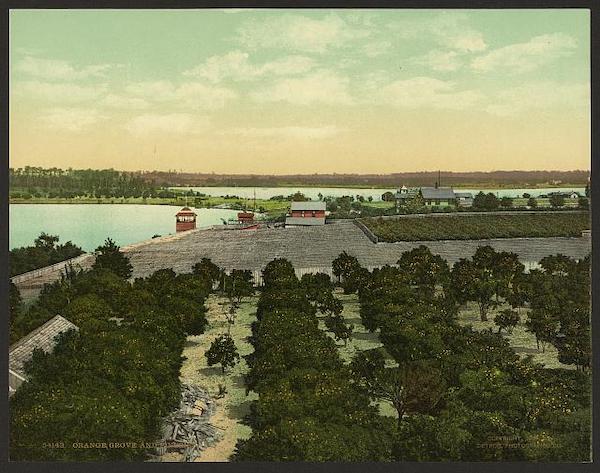
1904 image of an orange grove
A homestead grove in pre-modern Florida
might have looked like this 1904 one.
Credit: Library of Congress
Oranges are on my mind. I just finished reading Florida Oranges, A Colorful History, by Erin Thursby (American Palate, 2019). What a delicious book, pun intended. It's an enjoyable journey that illustrates just how deeply citrus and Florida are intertwined.

One of the hardest things for me to grasp was how much citrus dominated the state and its people in the past. When some people stampeded to the West to strike gold, others flocked to Florida where a different type of gold grew on trees. 

Advice for the Florida bound was plentiful. Books and pamphlets shared all kinds of details. One of these books in my online library is The Florida Settler, published in 1873. It covers more than citrus, but that’s the section I zoomed to. 

Lemons and limes were plentiful and productive in the state at that time. The author says the following about lime production in South Florida: “So profuse is the yield of fruit that in some places the ground is literally covered with it.” (49) Lime juice, the author adds, is “unquestionably the best remedy that can be employed in scurvy.” (49)

But oranges were king, and they grab the most attention of the fruits listed. The author says that, in the two years before the book’s publication - 1872 and 1871 - more than 2 million orange trees were planted in counties that bordered the St. Johns River. 

A person could get in on the action fairly easily. A “man of means” could set up a 10-acre citrus grove for $1,150, a little more than $28,000 today.* The price assumes the grower contracts out all the work. The valuation of the various components boggles me. The land itself - the 10 acres - cost only $25. The inflated worth of that amount is still only about $630 today. Imagine, 10 acres for less than the cost of a new smartphone. You could secure an online loan for that amount in minutes. 

Land clearing is budgeted at far more - $200 for the 10 acres. Breaking the ground after clearing is another $90 and fencing the property also another $90. That $380 amounts to nearly $10,000 today. 

The largest expenditure was $600 for 600 orange trees, each four years old. That’s $1 a tree. It equates to about $25 a tree today. Buying 600 at a time would put a dent in your budget: $600 in 1873 is some $15,000 today. 

Costs for moving and planting the trees were estimated at $100 ($2,500). Let’s not forget a year’s worth of fertilizer: five sacks of Peruvian guano at $9 each, for a total of $45. That would be expensive today - the $9 sacks would each cost $225. But we don’t know how big a sack was in 1873. It had to be large, because only five of them would last a year.

The "Man of Means" price chart is on page 41 of the Florida Settler book. It assumes the best of everything. The author points out that land clearing could be half the estimated account if the foliage wasn’t too thick. Two-year-old trees could be bought for 25 cents each. 

And who needs fences, when, as the author states, “the most successful of the old planters actually herd their cows around the young trees for weeks at a time, and maintain their trees by ‘cow-penning,’ using a fence for the purpose of keeping the cattle in the grove, instead of keeping them out.” (Emphasis included in the original text.)

The author helpfully follows luxury grove expenditures with a plan for those of lesser means. (42) “Cost for a Poor Man” began with free homesteaded land. Out of those 160 acres, 10 acres would be chosen for a grove. Existing trees would be deadened instead of removed, for $4 ($100). This man would raise his hundreds of trees from seed, from an initial outlay of $25 ($630). The biggest costs were for plowing, $50 ($1,260) and for planting and manure, $100 ($2,500). 

In all, the "poor man" could start his grove for $193 ($4,860), less if he did his own plowing, planting and other field work. 

Aside from the hard physical labor, a big difference in the two types of groves showed up in payback. A citrus tree starts to bear fully at about eight years old. The luxury grove would provide good returns in four years. The economy one wouldn’t show a profit for eight years. But it could be done. 

Within a decade, the economy grove would generate revenue between $5,000 ($126,000) and $10,000 a year ($252,000), according to the book. What that man needed most to get started was “patience and industry.” True words even today.

The author based his revenue estimates on the era's long-established groves. The famed Dummitt’s grove on the Indian River yielded 600,000 oranges in 1872. Dummittt earned $11,000 and production and maintenance had only cost $1,000. A grower named Hart in Palatka earned $15,000 to $20,000 a year from his grove, and another grower in Mellonville (now Sanford) earned $12,000 to $15,000 a year. These are all in 1873 dollars. The groves were sized between 1,100 and 3,000 trees.

The author happily noted the lack of problems with citrus, with scale being the most prevalent concern. No citrus canker, and certainly no citrus greening. 

The groves that once blanketed the state are long gone except in South Florida. Even within my lifetime, I remember seeing massive groves in Central Florida, but no more. What the freezes didn’t destroy, bacteria, viruses, and land developments did. 

In other blog posts, I’ve lamented the loss of abundant harvests from my backyard Meyer lemon and Robinson tangerine trees. Greening felled both trees. I’ve got a peach tree in their place now. The fruit is delicious. But it doesn’t say Florida the way citrus does - or did. I’m not sure anything can.

If you enjoy learning about citrus, read both the modern book and the older one. The full, cumbersome title of the 1873 one is: The Florida Settler, or Immigrants’ Guide; A Complete Manual of Information Concerning the Climate, Soils, Products and Resources of the State

Although I’ve cited the author throughout this post, the man who penned the book doesn’t call himself that. The title page says the book was “Prepared by D. Eagan, Commissioner of Lands and Immigration." It was printed in Tallahassee on July 1, 1873. I just realized that means it was printed a year shy of 150 years ago. Such a distant past is hard to conceptualize. So much has changed. But citrus has endured.

Wednesday, January 27, 2016

Chilly reminder of 1894-1895 freeze

Four photos of Florida citrus groves after the 1894-1895 freeze
These scenes from the 1894-1895 freeze are from a
NOAA-Preserve America Initiative fact sheet. 
Cold temperatures and ice caused the damage.

The same weekend Jonas blew through the Northeast, we dropped below freezing for the first time this winter. My weather app reported 30 degrees at about 8 a.m. Jan. 24, 2016. No snow, but for Floridians, a crisis of cold. We never got out of the 40s that day.

The cold snap was too short to do damage. But when I ventured outdoors - briefly - into a frosty 32 degrees the weather app said felt like 26,  I was reminded of the catastrophic and legendary 1894-1895 freeze. 

I scurried back into the warmth of central heating. There was no such thing back in the day. Cold outdoors equalled cold indoors, offset by inefficient fireplaces or wood-burning stoves whose warmth rarely reached bedrooms. 

The Big Freeze was what a Florida Citrus Mutual timeline calls an "impact freeze" because its severity caused serious economic damage and also rearranged the state's citrus industry. A Dec. 29-30, 1894 freeze was followed by unusual warmth, and then another hard freeze Feb. 7-9, 1895. 

Vintage photos of the aftermath are in the archives of cities and organizations scattered across Florida. The Rollins College Archives includes this photo in a blog post titled, "Rollins Reminiscences." All the oranges littering the ground represented lost income. In just one example of what happened statewide, the blog post relates how the freeze wiped out the college's endowment. The post also includes a British tourist's recollections of the orange trees turning black and the fruits turning into "lumps of yellow ice."

In both December and February, temperatures in Jacksonville dropped to 14 and winds blew at up to 35 mph. In Orlando, near where the Rollins photo was taken, temperatures dipped to 18 and 19. Those stats are from an interesting, online U.S. Department of Agriculture 1896 report written soon after the back-to-back disasters. 

The report also states that 3 million boxes of oranges and lemons were destroyed in the 1894 freeze, and the trees themselves were lost a few months later. The paper goes into great horticultural and meteorological detail, and is definitely worth a look if you're interested in that type of historical information. (2021 update: Unfortunately, the report no longer seems to be available online.)

Me, I'll be reading it in the warmth of indoors.


1895 photo of people standing in frozen orange grove with fruit on the ground
Rollins College photo of 1894-1895 freeze damage

Tuesday, September 30, 2014

Lue Gim Gong: past, present

Photo of Lue Gim Gong on ladder at citrus tree
Thanks to Florida Memory for this image
of Lue Gim Gong tending his citrus in DeLand.

Lue Gim Gong is probably one of the most gifted horticulturists you've never heard of.  He was both lauded and derided in his day - late 1800s to early 1900s. Lauded for his botanical prowess, derided for his ethnicity and his eccentricity. Today he is just mostly forgotten - but not in DeLand, where he developed the award-winning Lue Gim Gong orange.

The Chinese immigrant is on my mind because of recent action at the West Volusia Historical Society. The organization's Heritage Gardening Group is launching an effort to save extant Lue Gim Gong orange trees from citrus greening. I'm a member of that group, and excited about the project.

A recent generation of Lue Gim Gong trees grow on the grounds of the society's museum complex. Cuttings from aged trees were budded onto rootstock and planted in a small grove that frames a gazebo. A bronze bust of Lue is displayed in the gazebo. A mural of Lue is also featured in downtown DeLand.

I wonder how Lue would approach the greening menace. For sure, he'd be focused on developing a resistant variety. I like to think he'd be successful. Even Lue's detractors acknowledged his horticultural ability, although they took pains to denigrate his orange variety into oblivion.

The Lue Gim Gong orange was noted for its cold-hardiness and for holding its crop on the tree. Lue bred the variety by cross-pollinating Hart's Late and Mediterranean Sweet oranges.

The Lue Gim Gong orange was so outstanding it won a national industry award in 1911. Lue died in 1925. His orange also died, in a sense. It was dismissed as insignificant - a minor seedling of the more famous Valencia orange. (The once-named Hart's Late is now considered to have been the Valencia.)

I can't help but question the long-ago campaign to discredit Lue's work. The references I have seen, that label his citrus variety as minor, aren't attributed to a specific scientist or academic study. It's true Valencia holds its oranges on the tree, and is resistant to cold. But Lue's tree - the supporting structure itself - is said to have been far more cold-hardy than any other citrus tree. People clamored for Lue Gim Gong trees in the early 1900s. The trees were distributed by Glen Saint Mary Nursery, except for the many Lue was said to have given away.

The few accounts that remain describe Lue as brilliant, gentle, loyal to his mentor but distant with her siblings, devoted to his pets (two horses and a rooster), and a devout Christian with Confucianist roots. Legend says that, after his death, stacks of uncashed checks were found in the DeLand house he inherited from his mentor and mother-figure, Fannie Burlingame. She, by the way, is worth a blog post of her own.

Lue died penniless, and nearly friendless but for a few neighbors and townsfolk brave enough to challenge their era's bigotries. His horticultural records and journals disappeared. The least we can do is save his trees.

Learn more about Lue Gim Gong. He's worth it.