 |
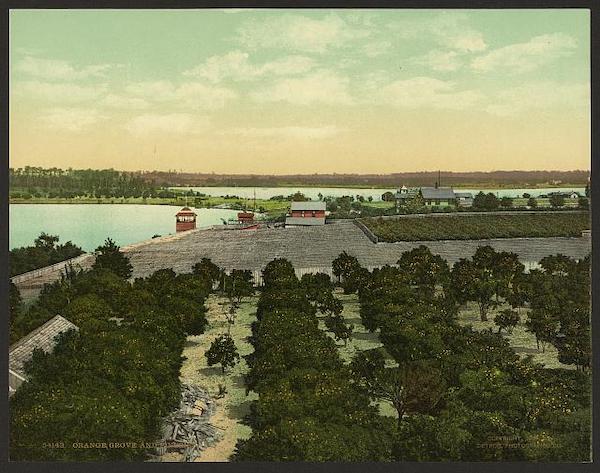
| A homestead grove in pre-modern Florida might have looked like this 1904 one. Credit: Library of Congress |
One of the hardest things for me to grasp was how much citrus dominated the state and its people in the past. When some people stampeded to the West to strike gold, others flocked to Florida where a different type of gold grew on trees.
Advice for the Florida bound was plentiful. Books and pamphlets shared all kinds of details. One of these books in my online library is The Florida Settler, published in 1873. It covers more than citrus, but that’s the section I zoomed to.
Lemons and limes were plentiful and productive in the state at that time. The author says the following about lime production in South Florida: “So profuse is the yield of fruit that in some places the ground is literally covered with it.” (49) Lime juice, the author adds, is “unquestionably the best remedy that can be employed in scurvy.” (49)
But oranges were king, and they grab the most attention of the fruits listed. The author says that, in the two years before the book’s publication - 1872 and 1871 - more than 2 million orange trees were planted in counties that bordered the St. Johns River.
A person could get in on the action fairly easily. A “man of means” could set up a 10-acre citrus grove for $1,150, a little more than $28,000 today.* The price assumes the grower contracts out all the work. The valuation of the various components boggles me. The land itself - the 10 acres - cost only $25. The inflated worth of that amount is still only about $630 today. Imagine, 10 acres for less than the cost of a new smartphone. You could secure an online loan for that amount in minutes.
Land clearing is budgeted at far more - $200 for the 10 acres. Breaking the ground after clearing is another $90 and fencing the property also another $90. That $380 amounts to nearly $10,000 today.
The largest expenditure was $600 for 600 orange trees, each four years old. That’s $1 a tree. It equates to about $25 a tree today. Buying 600 at a time would put a dent in your budget: $600 in 1873 is some $15,000 today.
Costs for moving and planting the trees were estimated at $100 ($2,500). Let’s not forget a year’s worth of fertilizer: five sacks of Peruvian guano at $9 each, for a total of $45. That would be expensive today - the $9 sacks would each cost $225. But we don’t know how big a sack was in 1873. It had to be large, because only five of them would last a year.
The "Man of Means" price chart is on page 41 of the Florida Settler book. It assumes the best of everything. The author points out that land clearing could be half the estimated account if the foliage wasn’t too thick. Two-year-old trees could be bought for 25 cents each.
And who needs fences, when, as the author states, “the most successful of the old planters actually herd their cows around the young trees for weeks at a time, and maintain their trees by ‘cow-penning,’ using a fence for the purpose of keeping the cattle in the grove, instead of keeping them out.” (Emphasis included in the original text.)
The author helpfully follows luxury grove expenditures with a plan for those of lesser means. (42) “Cost for a Poor Man” began with free homesteaded land. Out of those 160 acres, 10 acres would be chosen for a grove. Existing trees would be deadened instead of removed, for $4 ($100). This man would raise his hundreds of trees from seed, from an initial outlay of $25 ($630). The biggest costs were for plowing, $50 ($1,260) and for planting and manure, $100 ($2,500).
In all, the "poor man" could start his grove for $193 ($4,860), less if he did his own plowing, planting and other field work.
Aside from the hard physical labor, a big difference in the two types of groves showed up in payback. A citrus tree starts to bear fully at about eight years old. The luxury grove would provide good returns in four years. The economy one wouldn’t show a profit for eight years. But it could be done.
Within a decade, the economy grove would generate revenue between $5,000 ($126,000) and $10,000 a year ($252,000), according to the book. What that man needed most to get started was “patience and industry.” True words even today.
The author based his revenue estimates on the era's long-established groves. The famed Dummitt’s grove on the Indian River yielded 600,000 oranges in 1872. Dummittt earned $11,000 and production and maintenance had only cost $1,000. A grower named Hart in Palatka earned $15,000 to $20,000 a year from his grove, and another grower in Mellonville (now Sanford) earned $12,000 to $15,000 a year. These are all in 1873 dollars. The groves were sized between 1,100 and 3,000 trees.
The author happily noted the lack of problems with citrus, with scale being the most prevalent concern. No citrus canker, and certainly no citrus greening.
The groves that once blanketed the state are long gone except in South Florida. Even within my lifetime, I remember seeing massive groves in Central Florida, but no more. What the freezes didn’t destroy, bacteria, viruses, and land developments did.
In other blog posts, I’ve lamented the loss of abundant harvests from my backyard Meyer lemon and Robinson tangerine trees. Greening felled both trees. I’ve got a peach tree in their place now. The fruit is delicious. But it doesn’t say Florida the way citrus does - or did. I’m not sure anything can.
If you enjoy learning about citrus, read both the modern book and the older one. The full, cumbersome title of the 1873 one is: The Florida Settler, or Immigrants’ Guide; A Complete Manual of Information Concerning the Climate, Soils, Products and Resources of the State.
Although I’ve cited the author throughout this post, the man who penned the book doesn’t call himself that. The title page says the book was “Prepared by D. Eagan, Commissioner of Lands and Immigration." It was printed in Tallahassee on July 1, 1873. I just realized that means it was printed a year shy of 150 years ago. Such a distant past is hard to conceptualize. So much has changed. But citrus has endured.


