Saturday, October 30, 2021

Solitude walked with pioneers

photo of restored 1800s farmhouse and historical marker
Webb farmhouse in Mandarin

Family bubbles, social distancing, and online opportunities to connect eased my solitude during the height of our never-ending pandemic. A recent discovery of a small historical park made me realize that solitude walked beside every pioneer in frontier Florida, all the time. 

I realized that during a stroll through a historical site new to me. My husband and I were traveling side streets in the Mandarin neighborhood of Jacksonville when we arrived in town earlier than expected for a funeral. We found a hidden gem: the Walter Jones Historical Park, perched on the banks of the St. Johns River.

This being a pandemic, the site's historical buildings were closed to visitors but the park was open for walking. And it was during my walk along the nature trail, toward the river, that the solitude thought struck me. Everything was so quiet. Few people were out and about that day. It was easy to imagine that a hundred or more years had just been lopped off the calendar. Easy to realize that every day back then, the people on this and other homesteads were far removed from each other.

Mandarin is one of the older neighborhoods of Jacksonville, best known today as the place where writer Harriet Beecher Stowe wintered in the late 1800s. At first I wondered if the historical park contained her house. It doesn't. A historical sign marking the site where her home once stood is about a mile away.

The park features a collection of period buildings, one of which contains the Mandarin Museum and Historical Society. Others are the St. Joseph's Mission Schoolhouse for African-American Children, an old barn, a sawmill, barnlike winery and the 1875 Webb farmhouse.

The Webb farmhouse fronts the river. In its time, it was surrounded by 30 acres of farmland. The river, not the land behind the house, was the major highway of its day. It was a lifeline for people who lived in isolated pockets before rail lines reached them in succeeding years.

The quietness and isolation of those early lives seemed so real during my walk. My husband was on another section of the trail and I was alone. There was peace and beauty in the land and water around me. But the beauty of the human connection was made clear by its absence. I never noticed such a feeling quite like I did that day, in that place.

I like to spend a lot of time alone. But too much of even that good thing is unhealthful. We're made to love and help ease each other's journey through life. Much as pioneers did when they were able to bridge the miles between them. Much as we should still do today, even though the miles aren't always physical anymore. They're metaphorical. And it's crucial that we bridge them.

Sunday, September 26, 2021

Marian shrine endures

Photo of exterior of Our Lady of La Leche chapel
The national shrine is in St. Augustine

October 2021 brings renewed attention to the National Shrine of Our Lady of La Leche at Mission Nombre de Dios in St. Augustine. 

The shrine was founded earlier than what's covered in the scope of this blog. But it was a fixture of Florida Catholic life in the time period I cover. It was so beforehand, and still is today.

Early Spanish settlers established this first shrine to the Blessed Virgin Mary in what is now the United States in the early 1600s. They did so at Mission Nombre de Dios, also a "first" site. It's where the first Mass in what is now the United States was celebrated in 1565.

In those early days, the sanctuary in the small chapel at Mission Nombre de Dios had a statue of Mary breastfeeding the baby Jesus. According to the Early History of the Catholic Parishes and Missions of  Florida, pregnant and nursing Spanish and native women started to make pilgrimages to the chapel in the 1620s. They prayed for safe deliveries and for the health of their children and themselves.

The Marian devotion continues at the chapel to this day. Pilgrims from around the world come to pray at Our Lady of La Leche and Buen Parto (Our Lady of the Milk and Happy Delivery). But the chapel that visitors pray in today isn't the same one those early women gathered in. A combined force of English and Native Americans burned down the church and stole the statue in 1728. 

The chapel was rebuilt of stone and another statue of Mary was brought from Spain and installed. But Early History points out that the chapel had to be rebuilt several more times after being destroyed by storms or other forces through the years. One of those destructive episodes took place in the 1870s. Another was in 1914, when anti-Catholicism was at high pitch in Florida. 

Each time, the chapel rose again and the Marian devotion continued unabated. Our Lady of La Leche is stronger than any evil force. Now, 400 years after small numbers of immigrant and native women first joined hands in prayer in St. Augustine, a larger group will gather Oct. 10 for a canonical coronation. It's a Catholic honor granted only by the Pope, in which a crown or halo is bestowed on a statue that is widely venerated. 

The coronation ceremony will take place at the cathedral in St. Augustine. It was to have occurred in October 2020, but COVID put a halt to that. A little earlier, in 2019, the U.S. Conference of Catholic Bishops granted national shrine status to Our Lady of La Leche.

Let's pray that the shrine remains holy and venerated for another 400 years, or more.

Saturday, August 28, 2021

This murder no mystery

Vintage head and shoulders image of Fr. James Coyle
Fr. James Coyle. Credit: Starquest Media
I'm on a mission to get people to learn history. It's so important. Yes, it's written by the victors but the losers often find ways to air their story. It's important to learn about both sides. And to learn truth, not biased fabrications from anyone who has an extremist agenda, right or left. But learn. Please. 

Onward to today's glimpse of the past: the 1921 murder of a Catholic priest in Alabama. (I figure it's close enough to Florida.)

I'm a history fan and I knew nothing of this incident until a couple of weeks ago. The American Catholic History podcast did an episode about the killing of Father James Coyle. Find the show and episode on your favorite podcast platform or listen via the Starquest Media website.

In a nutshell, Fr. Coyle was gunned down by a Methodist Episcopal minister who was angry because his daughter had converted to Catholicism. And had then married a man who was Puerto Rican. And that Fr. Coyle had performed both the baptism and the marriage ceremony.

Pastor of the cathedral in Birmingham, Fr. Coyle wasn't even 30 years old yet. This being 1921 Alabama, the minister was acquitted at his trial. Apparently he and his court system cronies were all members of the locally powerful Ku Klux Klan. Wikipedia says the Klan even paid for the minister's defense.

But there's a brighter side to this sad story. People reallly were shocked. I mean, Fr. Coyle was sitting on his front porch and the angry minister strode up and shot him in the head. The anti-Catholic sentiment that was heavy and strong in that time and place started to wane slowly - very slowly. 

Pockets of anti-Catholicism remain, even now, but nothing like in the past. I went to a non-Catholic funeral a few years ago in a small town in Florida. The Penecostal pastor refused to shake hands or look me in the eye as we filed out after the service. He'd seen me make the sign of the Cross during the service. 

That was one person, not an entire congregation or denomination. But you have only to look around for a few seconds to see the division that separates people today. I'm firmly in the camp that extends a hand and wants to sit down and talk. I just buried my parents' cremains a week ago after a COVID-induced delay of many months (years in my mother's case). I'm reminded that life is short. And that love is what matters.


Thursday, July 29, 2021

Benedictines were early arrivals

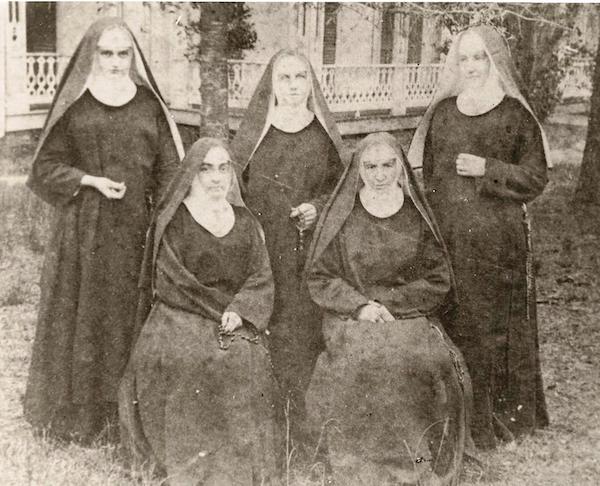
Old photo of 5 Benedictine sisters in Florida
These women were first Benedictine sisters
to arrive in Florida. They got here in 1889.
(Photo credit: Holy Name Monastery)

St. Leo University, one of the largest Catholic universities in the country, is also the oldest Catholic institution of higher education in Florida. 

Its home base in Florida shares the town of St. Leo with a low-key monastery and abbey - Holy Name Monastery (a Benedictine convent) and St. Leo Abbey (a Benedictine monastery). 

Today, the community of about 1,000 or so people is considered a suburb of the massive Tampa-St. Pete metropolis. But it was rural and wild when the institutions took root in the 1800s.

Benedictines established the college, abbey, and monastery in 1889. The town of St. Leo didn't yet exist. The missionary endeavors were planted on the shore of Lake Jovita near the small town of San Antonio - Florida, not Texas.

Catholics in Florida were few and far apart in that part of central West Florida. The Benedictines settled on ranch land that Wikipedia says was the former homestead of Judge Edmund F. Dunne. We're not talking any old homestead. More like a 100,000-acre homestead. Dunne received the land as a commission for his legal assistance in the Disston Land Purchase. 

Without digressing too much, let me just say the Disston Land Purchase was connected to the now-bizarre idea to drain the Everglades. It was considered an innovative plan in the 1880s.

Dunne, meanwhile, is credited with establishing a Catholic colony in Florida's San Antonio in 1882. The judge came to Florida after being removed from the bench in Arizona. He wasn't booted off for legal reasons but for his religious zeal.

Dunne didn't stay in Florida all that long. He deeded his land to the Benedictines and left in about 1889. The Benedictines stayed.

Benedictine priests were early arrivals. The first priest arrived in 1886 and the Benedictine brothers followed a few years later and established the abbey and the college in 1889.

Five Benedictine sisters also arrived in 1889 to launch their educational efforts. They came to Florida from Pennsylvania and started teaching the very next day, says the Benedictine Sisters of Florida website.

Challenges don't daunt Catholic nuns. The Benedicines actually had their school building moved a mile uphill to a new location in 1911 because they couldn't afford to build a new one. On a side note, the Mother Superior - Mother Rose Marie - was the first woman in Pasco County to have a driver's license.

The sisters focused on elementary and secondary education. The college was overseen by Benedictine brothers and priests from St. Leo Abbey. The state legislature had authorized the Order of St. Benedict of Florida to establish the university in 1889.

These priests and men and women religious didn't just stay in the neighborhood. They ministered throughout a Florida region that was sparsely settled and difficult to travel through. It was a strange, amazing new land for the newcomers. Read the letters of Benedictine Florida pioneer Gerald Pilz, O.S.B. online to learn of his first impressions. 

Catholics on the frontier appreciated the efforts of these clergy and religious, who were heroic in their efforts to minister and teach. Distance may have separated all these Catholics in the wilderness, but their shared faith kept them close. 

Monday, June 28, 2021

Here's to unsung pioneer heroines

Head and shoulders image of Dr. Josie Rogers as a young woman
Dr. Josie Rogers

I recently read the excellent The Doctors Blackwell bio. The book made me think about Dr. Josie Rogers (1876-1975). She's locally famous in my area but otherwise little known. 

Every city or county in the country probably has their version of a Dr. Rogers. Locally known but otherwise obscure. Such a shame. They likely were fascinating people.

I was familiar with Dr. Elizabeth Blackwell because I read a YA biography of her when I was a pre-teen. Until I read the 2021 biography I didn't realize her sister, Emily, was also a pioneering woman doctor. 

The legacy of both Blackwells has been overshadowed. They didn't fit into the narratives controlled by contemporaries who promoted their own agendas. The Blackwell sisters not only faced discrimination from men. At times they were pushed aside by other women. Those others shaped written history - at least the history I learned.

That made me wonder where Dr. Rogers fit into narrative of her time. She was born in Daytona Beach the same year the town became a city - 1876. Her family was educated and fairly well-off, but they were still pioneers. In Dr. Rogers' short reminiscences of the city's early years, she wrote about wild animals prowling on the porch in search of food. 

The anecdote contains wonderful details. The cupboard was made of red cedar and had a mahogany top. Wire screening enclosed the cupboard on three sides. "Mother said she often heard wild cats scratching at the wire..." Dr. Rogers wrote in In Retrospect - Daytona and the Early Years. 

The 26-page booklet doesn't list a publisher or a publishing year. It does note Dr. Rogers wrote her memories in 1948. So, she was in her early 70s when she looked back.

By that time, Dr. Rogers had a string of accomplishments to her credit. The unsigned introductory page of Retrospect lists them. There are too many to recount here. 

Dr. Rogers earned her M.D. degree in 1907 in Chicago. She practiced in and around Daytona Beach for close to 50 years. Her career included stints as school physician and a county doctor for the Florida state board of health. She was chief of staff at what was then called Halifax District Hospital in 1947. 

She also served as a city commissioner and was elected Daytona Beach's first woman mayor in 1922. Add in the many community and civic organizations she either pioneered or supported and you have an amazing life. But I don't know much about the person herself. 

She came from a family of achievers. That's obvious. Her sister became a college professor, her older brother an engineer, and her younger brother a land developer. The introduction to her reminiscences describes her as "devoted to her family" and "a wise counsellor and staunch friend with a keen mind and sharp wit." 

Tight family bonds are evident in her stories of the past. She loved to visit her grandparents, who also lived in Daytona Beach. She got along well with her siblings and didn't cause any trouble to her parents. Extended family members were a close and welcome part of her life.

Her attention to detail is everywhere. She recalled the overland leg of the trip home after visiting relatives in her parents' native New Jersey. This was before the railroad reached  Daytona, so she was still pretty young.

Her mother, grandmother, aunt, and she and her siblings traveled from St. Augustine to Daytona in a wagon. They all rode in the back, seated on hay. The driver got lost, which caused a great deal of worry among the adult women. 

Dr. Rogers remembered waking up in the middle of the night to hear the women whispering. The driver had stopped at a house. A stranger emerged, got on a mule, and started leading the wagon through the woods. Dr. Rogers says the adults feared for their lives. But the stranger turned out to be simply a guide.

As dawn broke, they were halfway to Daytona and stopped at a cabin that had a swept yard. "To this day, when I smell chicory coffee it brings back memories of that meal when the grits and fried salt pork with corn pone tasted delicious to us hungry travelers," she wrote. "Father was greatly worried by our delay and was making arrangements to search for us when we arrived (home)."

She recalled often receiving books and reading magazines. She was one of the young readers who waited for each new book from Louisa May Alcott. She received them "as fast as they were published."  

Interestingly, a book Dr. Rogers mentioned was Eminent Women of the Ages. One of the women profiled in it was a cousin of her great-grandmother. That distant relative, Clemence Lozier, was one of the first women doctors in New York City. 

Dr. Rogers never married. Neither did her sister. Dr. Rogers' reminiscences include anecdotes about a few local women who lived independent lives. I could speculate they provided models of options available for women. But she had equally influential models of women who chose traditional roles.

She wrote engagingly of people and places, pioneer experiences, community life, and her childhood self. What she didn't write about were her teenage years, her schooling, or her adult self. Perhaps she did. Maybe they're part of her unpublished papers. Just waiting for a biographer. 

More information about Dr. Rogers shows up on genealogy websites including Find A Grave and a family genealogy website. The Rogers family home, built in 1878, still stands in Daytona Beach. Read its 1986 nomination for the National Register of Historic Places. 

Historic Rogers house in Daytona Beach, FL
Dr. Rogers lived, worked, and died in the
historic family home, now owned by the city
of Daytona Beach. For restoration reasons,
the city had the house moved a short 
distance, as this 2020 video shows.

Sunday, May 30, 2021

Don't blow off hurricane warnings

partial cover of "Memoirs of an Everglades Pioneer"
Memoir tells of the 1928 hurricane

Well, we're back in another hurricane season. Not something to be taken lightly. 

Early settlers had their share of storms and the results could be frightening. Like today, it depended on the severity of the storm and its path. Two pioneer memoirs illustrate that in a vivid way.

The lighter remembrance was viewed through childhood eyes. Maria Davidson Pope wrote Remembrances of an Early Daytona Childhood fairly late in life - in her 60s or older. She was born in Daytona in 1874 and died at age 94 in 1969. 

She recounts with great detail the people and times of her youth. That includes periods of bad weather. As a child, she looked "forward to the fall gales with delight." These storms may or may not have been hurricanes. They were fierce enough to rattle windowpanes and blow boats loose from the wharves.

Flooding was a given on the low riverfront land. To lively children in a safe haven, that was an adventure. When the kitchen flooded, they played in the water, she wrote. "I remember paddling around on a small wooden table, turned upside down. Our great delight was to walk on stilts through the water. I so well remember the Puckett boys making me those stilts." 

Adults have different perspectives. In Memoirs of an Everglades Pioneer, Gertrude Petersen Winne shared dramatic memories of the horrible 1928 hurricane that tore through South Florida and killed thousands of people. 

There's a world of difference between a fall gale and that vicious 1928 storm, known as the Okeechobee Hurricane. An excellent fictional account is in Zora Neale Hurston's novel Their Eyes Were Watching God. I'd long thought the underprivileged bore the brunt of that storm. Winne's memoir tells me otherwise. Rich and poor alike suffered. One difference is that more well-off residents may have had better access to weather forecasts. 

Winne and her family lived near the edge of Lake Okeechobee. Her husband was a fisherman in tune with the ways of wind and water. They heard the storm forecasts and watched conditions closely. "When the water in the creek rose 6 inches in 15 minutes, Ross [her husband] said, 'It's time to go.' "

They grabbed a few belongings and set out for West Palm Beach. They encouraged neighbors to do the same. Most declined. All - or almost all - who stayed behind died. The Winne family's three-story house was washed off its foundation and destroyed. 

The family almost didn't make it, themselves. The storm lashed into them before they reached West Palm. The car stalled out. When her husband opened the car door, the wind tore it back and bent the hinges. He shielded himself until a short break in the wind allowed him to get the door back on and get inside the vehicle. He'd also pushed the car into deep sand for stability and put rocks in front of the wheels. 

The couple and their children huddled inside the vehicle. They watched pine trees bend to the ground under the wind, saw roofs peel off buildings, and prayed that debris flying all around them wouldn't smash into the car. "During all this, the car surged and swayed like a mad ship but did not break loose from its mire of sand," Gertrude wrote.

During the eye of the storm, they got out and found that the paint on the car's exterior had been scoured off by flying sand. And heavy timbers had been forced into the asphalt pavement only a few feet behind the car. The family got the car started and managed to limp to safety in town, sometimes first getting out of the car and clearing the roadway of debris.

As soon as the storm ended, rescuers including Gertrude's husband headed out to the Everglades, she wrote. "The first truck to return from the Glades came in about 10 o'clock that night loaded with men, women, and children. Ross said if he lived to be a hundred, he would never forget the look on those people's faces - utter hopelessness and despair; some of the people looked so blank and bewildered they had to be led by hand."  

Gertrude wasn't able to return home for over a month. Her husband helped nonstop with rescue efforts and with burying the dead. It was gruesome. "Death. Death and destruction lay everywhere," she wrote. "Some 2,000 or 3,000 people lay dead, scattered over the countryside..." 

If you live in a hurricane zone and a warning is issued, heed it. Please. We're a century past these pioneer experiences, but some things don't change. The destructive powers of hurricanes are one of them. 


To learn more about the 1928 Okeechobee Hurricane, see the National Weather Service's memorial page at https://www.weather.gov/mfl/okeechobee

Monday, April 26, 2021

Searching for paradise in Daytona

Screen grab of part of 1909 newspaper
Mrs. Crane talked about how to 
improve Daytona Beach
I'm a sewist and a fan of old sewing machines. So I took notice when learning that Thomas H. White once frequented Daytona Beach. The industrialist - a sewing machine manufacturer, among other things - was a repeat winter guest in the early 20th century. 

What I discovered after researching his visits here had nothing to do with sewing. No, I turned up a 100-year-old problem that still plagues the coastal city.

That White chose Daytona Beach isn't surprising. He was also an automotive pioneer and one of his companies was the White Motor Company. 

White was among the 1 percent of the time. His comings and goings in Daytona were newsworthy. On Jan. 15, 1909, an excursion earned front-page coverage. 

He and two couples "made a trip to Allenhurst ... by automobile in two and one-half hours' time." The party returned with fish and ducks and deemed their trip a success. 

Allenhurst no longer exists, but it was a sport fishing hot spot at the time. Today its land is part of NASA in Brevard County. 

Getting to Allenhurst from Daytona in two and a half hours in 1909 was, yes, somewhat newsworthy. It meant the travelers averaged about 25 mph. You might laugh, but regular vehicles' top speeds were 40 to 45 mph back then. Only daredevils on beach runs hit the 90s, 100s, and higher mphs. 

Plus, road conditions were treacherous. The newspaper reporter commented on the good travel time, and said White and his group "found the road in fairly good condition." That means they didn't have to stop and dig themselves out of deep sand too often.

White's wife didn't accompany the travelers to Allenhurst. You'll soon learn why. But she, too, garnered her own newspaper coverage. One example is part of Local News on the front page of the Daytona Daily News on March 20, 1909

Mrs. White had hosted a theater party. She invited "a party of a dozen to witness the performance, 'How Wives Fool Their Husbands,' in the tent show. The guests entered into the spirit of the occasion and enjoyed a merry evening." 

The tent show was a big happening in town, with the apparently popular show presented by a visiting troupe.

The busy social season revolved around the year's Great Automobile Race Tournament. The March 23 edition of  the newspaper reported that a stiff north wind had blown the beach into perfect shape for the sixth edition of beach racing. Races started that day.

"All the famous professional drivers in the country are gathered here," the paper said. 

Town was abuzz with the sport's and its fans' A-listers, and social events swirled in elite neighborhoods. The March 20 article had referenced only Mrs. Thomas H. White (no first name given) but it did mention that the Whites were of South Beach Street. The prime riverfront real estate was an ideal location for a theater party.

The Whites maintained a busy social life even when it wasn't race week. On Jan. 14, 1909, the paper noted that Mrs. White and her houseguests took an "automobile trip to DeLand." One of the guests, a Caroline Bartlett Crane, wanted to see the county seat. 

Mrs. Crane was a guest of note at the White residence, and likely the reason Mrs. White didn't join the travelers to Allenhurst. 

Mrs. Crane, of Michigan, was a speaker of national importance. The same page of the newspaper that included the Allenhurst trip news also featured two - not one - two articles about addresses presented by Mrs. Crane.

She enlivened a meeting of the local Palmetto Club during the ladies' regular gathering. Of more importance was the public evening address the "noted Civic League lecturer" gave at the town Armory. The event had been organized by the Palmetto Club.

Mrs. Crane "delights and instructs a representative audience" the newspaper headline stated. The large Armory was filled to standing-room only.

The crowd's size proved how much local people had an "interest in a better, a bigger and more beautiful Daytona," the reporter said. They even braved inclement weather in order to attend.

Yes, the noted lecturer was in town to talk about how to improve Daytona Beach. In 1909. More than a century later, noted lecturers still come to Daytona Beach and still talk about the same thing. 

Mrs. Crane "held Daytona up for inspection, introspection and a retrospection, and by various comparisons showed what better things may be attained," the article stated. Beautifying the waterfront was mentioned.

Here's my favorite line. The article says Mrs. Crane quoted a recent Daytona Daily News commentary "in which it was pointed out that Daytona Beach could and would approach within a stone's throw of paradise if only the people would work toward that end."

That 1909 sentence remains true today. How sad. The city is still trying to beautify the waterfront. Still trying to get close to paradise. People are still trying to work together. What has been going on for the past century?

Daytona Beach long ago lost its appeal for winter residents like the Whites. On a side note, their name lives on in town, at White Hall at Bethune-Cookman University. White was also a philanthropist (a White foundation still exists today). He knew Mary McCloud Bethune and donated generously to her school.

A lot of good people have spent - and continue to spend -  a great deal of time, money, and effort to improve Daytona Beach. They've been at it for over 100 years. As the 1909 reporter said: "... it is sincerely hoped that they may strike home." Soon.