Showing posts with label women. Show all posts

Sunday, December 28, 2025

Finding frontier joy

Citrus groves surrounded by pine forests
were a common sight in pioneer Florida.
Image credit: Florida Memory state archives,
https://www.floridamemory.com

Women in the 19th century had little legal or social recourse when husbands decided to move their families to frontier areas. Citrus fever caused more than a few such moves to Florida. 

Relocating from a settled, populated Northern or Midwestern state to a semi-tropical wilderness was a shock to many a newcomer. Many places have local history stories of a wife who spent her first months here crying. My own town has such a story. 

Prevailing attitudes at the time assumed that women who ended up here labored unwillingly and unceasingly and were unhappy and unfulfilled. The business of growing citrus empires and settling new towns was men's work. 

Or was it? Certainly, in some cases wives and daughters disliked living in Florida. But many women exhibited resilience, resourcefulness and joy in their new life. They discovered a freedom denied them by the social rules and structures "back home."

Even the woman in my town's history dried her tears and shook off her homesickness. She set out to find every settler she could in the vicinity. Why? She was fundraising. She wanted a church built. And she succeeded.

Come to my Sunland, the letters of pioneer Julia Daniels Moseley, likewise contains vivid accounts of how she first struggled, then came to love, the area near Tampa where she and her husband settled in the 1880s. It's a book worth reading.

These weren't outlier stories. Information in an article in the Summer 2012 (volume 91) issue of the Florida Historical Society Quarterly reinforces that. 

The main focus of the article by John T. Foster, Sarah Whitmer Foster, and Roscoe A. Turnquest is about a journalist named Ellen Augusta Morgan Hill. She expanded the depth and breadth of the women's page content she wrote for the Jacksonville-based Florida Dispatch in the 1880s. She engaged with her readers and shared her strong opinions. Among them:

  • citrus-obsessed husbands needed to show more consideration, courtesy and affection to their wives.
  • women shouldn't be limited to housekeeping and parenting (a radical thought at the time).
  • men liked Florida much more than women did.
That last statement drew letters of disagreement from Florida transplants from the North and Midwest. "Rather than listing grievances many of the women along Florida's frontier described the simple pleasures of life," the article states.

Some of the comments are almost poetic. One woman wrote: "... to you who dwell among the pines of Florida I would ask ... Did you ever sit at dusk and listen to them, how they begin to whisper...?"  Did you ever, she asked, listen to them on a pleasant day "almost sing you a lullaby as you lazily swing to and fro in a hammock?"

I have listened to pines in the Ocala National Forest. I can indeed tell you the sound of wind through the boughs is beautiful and almost ethereal. 

Another woman wrote of loving how she found "... so much to occupy her time, from my little chicks to my little babe." She went on to list things she enjoyed, from vegetable gardening to tending all sorts of fruit trees. "I feel I am the happiest woman in the world," she wrote.

Even the ever-present Florida bugs and the famous Florida heat weren't problems for these pioneers. One transplant suggested readers head to Cincinnati if they wanted to feel oppressive summer heat. Others told how mosquito nets and screens repelled the insects. One reader offered a recipe for a boric acid mixture that took care of roaches. And more than a few shared tips for ensuring a safe water supply. 

If anything, these readers said they and their families were in better health in Florida than they had been elsewhere. Several had in fact relocated due to health. And yes, citrus factored into many, if not all, of these homesteaders' lives. 

Citrus in Florida has dwindled so much it's hard to remember when groves blanketed the state. Those days are history. But people still come here for their health. And a lot of women who relocate are happy here. This writer included.

Saturday, February 26, 2022

Sicilian needlework stories wait to be told

detail image of Sicilian embroidery
Detail of a whitework tablecloth that my
 grandmother Rose Russo Puccio

embroidered in the early 1900s.
(Photo credit: Gerri Bauer)

Maybe I'm not looking in the right places. Dig as I might, I find little about the cutwork embroidery and other needlework done by immigrant Sicilian and other Italian women in early 20th century Florida. Yet I know it was being done.

I wonder where those works of art are today. Handed down in families? Or are they the pieces I see for sale on eBay, Facebook and elsewhere online?

The question arose after I recently took out and refolded the family heirloom linens I inherited. My Sicilian immigrant grandmother created them in New York City between 1910 and 1918. In the same era, a sizeable cluster of Sicilian immigrant women lived and worked in Tampa's Ybor City. Information about their role in the city's cigar-making industries is fairly easy to locate. Information about their domestic lives, not so much.

Yet, as historian and USF professor emeritus Gary Mormino pointed out in a 1983 Florida Historical Quarterly article about Ybor City Italian women, it was family - not work - that was the primary focus of these women. That was true even when they worked outside the home.

Everyone labored to ensure the family survived and thrived. In the early 20th century, Sicilian children routinely were pulled from school and sent to work. My grandmother had only a third-grade education. Her counterparts in Florida had similar experiences.

Mormino's article isn't about needlework. But within it, a sentence tells me how much the traditional and cultural Sicilian skill remained an integral part of immigrant life in Ybor City: "While at home, Italian women somehow found time to continue the handicraft arts of sewing, crocheting, and embroidering."

My Sicilian grandmother worked in a sweatshop, yet turned out beautiful embroidered needlework including the piece pictured with this blog. She was from the same region of Sicily as most of the Sicilian women in Ybor City. Needlework was an important part of their lives. It wasn't a hobby as it is today for me. They were making bed and table linens for their trousseaus. They were preparing for future family life.

So, I have a lot of questions. Did these women in Tampa sit and sew together? Did they bring handworks-in-progress to community outings? Did the needlework provide cultural closeness to all they'd left behind? Where did the designs come from? What stores supplied the fabric and thread? Were the materials mailed to the women by relatives? 

Above all, where did all that beautiful cutwork embroidery and other needlework go? I speak of the pieces that were special, not the everyday ones used until threadbare. Some of the fine needlework is artistic and belongs in museums. Is it showcased anywhere?

Traditionally, the finest pieces were handed down. But even that practice is fading. Younger generations aren't as interested in the heirloom linens. Yet each piece has a face, a life, a story behind it. They cry out to be remembered.

Monday, June 28, 2021

Here's to unsung pioneer heroines

Head and shoulders image of Dr. Josie Rogers as a young woman
Dr. Josie Rogers

I recently read the excellent The Doctors Blackwell bio. The book made me think about Dr. Josie Rogers (1876-1975). She's locally famous in my area but otherwise little known. 

Every city or county in the country probably has their version of a Dr. Rogers. Locally known but otherwise obscure. Such a shame. They likely were fascinating people.

I was familiar with Dr. Elizabeth Blackwell because I read a YA biography of her when I was a pre-teen. Until I read the 2021 biography I didn't realize her sister, Emily, was also a pioneering woman doctor. 

The legacy of both Blackwells has been overshadowed. They didn't fit into the narratives controlled by contemporaries who promoted their own agendas. The Blackwell sisters not only faced discrimination from men. At times they were pushed aside by other women. Those others shaped written history - at least the history I learned.

That made me wonder where Dr. Rogers fit into narrative of her time. She was born in Daytona Beach the same year the town became a city - 1876. Her family was educated and fairly well-off, but they were still pioneers. In Dr. Rogers' short reminiscences of the city's early years, she wrote about wild animals prowling on the porch in search of food. 

The anecdote contains wonderful details. The cupboard was made of red cedar and had a mahogany top. Wire screening enclosed the cupboard on three sides. "Mother said she often heard wild cats scratching at the wire..." Dr. Rogers wrote in In Retrospect - Daytona and the Early Years. 

The 26-page booklet doesn't list a publisher or a publishing year. It does note Dr. Rogers wrote her memories in 1948. So, she was in her early 70s when she looked back.

By that time, Dr. Rogers had a string of accomplishments to her credit. The unsigned introductory page of Retrospect lists them. There are too many to recount here. 

Dr. Rogers earned her M.D. degree in 1907 in Chicago. She practiced in and around Daytona Beach for close to 50 years. Her career included stints as school physician and a county doctor for the Florida state board of health. She was chief of staff at what was then called Halifax District Hospital in 1947. 

She also served as a city commissioner and was elected Daytona Beach's first woman mayor in 1922. Add in the many community and civic organizations she either pioneered or supported and you have an amazing life. But I don't know much about the person herself. 

She came from a family of achievers. That's obvious. Her sister became a college professor, her older brother an engineer, and her younger brother a land developer. The introduction to her reminiscences describes her as "devoted to her family" and "a wise counsellor and staunch friend with a keen mind and sharp wit." 

Tight family bonds are evident in her stories of the past. She loved to visit her grandparents, who also lived in Daytona Beach. She got along well with her siblings and didn't cause any trouble to her parents. Extended family members were a close and welcome part of her life.

Her attention to detail is everywhere. She recalled the overland leg of the trip home after visiting relatives in her parents' native New Jersey. This was before the railroad reached  Daytona, so she was still pretty young.

Her mother, grandmother, aunt, and she and her siblings traveled from St. Augustine to Daytona in a wagon. They all rode in the back, seated on hay. The driver got lost, which caused a great deal of worry among the adult women. 

Dr. Rogers remembered waking up in the middle of the night to hear the women whispering. The driver had stopped at a house. A stranger emerged, got on a mule, and started leading the wagon through the woods. Dr. Rogers says the adults feared for their lives. But the stranger turned out to be simply a guide.

As dawn broke, they were halfway to Daytona and stopped at a cabin that had a swept yard. "To this day, when I smell chicory coffee it brings back memories of that meal when the grits and fried salt pork with corn pone tasted delicious to us hungry travelers," she wrote. "Father was greatly worried by our delay and was making arrangements to search for us when we arrived (home)."

She recalled often receiving books and reading magazines. She was one of the young readers who waited for each new book from Louisa May Alcott. She received them "as fast as they were published."  

Interestingly, a book Dr. Rogers mentioned was Eminent Women of the Ages. One of the women profiled in it was a cousin of her great-grandmother. That distant relative, Clemence Lozier, was one of the first women doctors in New York City. 

Dr. Rogers never married. Neither did her sister. Dr. Rogers' reminiscences include anecdotes about a few local women who lived independent lives. I could speculate they provided models of options available for women. But she had equally influential models of women who chose traditional roles.

She wrote engagingly of people and places, pioneer experiences, community life, and her childhood self. What she didn't write about were her teenage years, her schooling, or her adult self. Perhaps she did. Maybe they're part of her unpublished papers. Just waiting for a biographer. 

More information about Dr. Rogers shows up on genealogy websites including Find A Grave and a family genealogy website. The Rogers family home, built in 1878, still stands in Daytona Beach. Read its 1986 nomination for the National Register of Historic Places. 

Historic Rogers house in Daytona Beach, FL
Dr. Rogers lived, worked, and died in the
historic family home, now owned by the city
of Daytona Beach. For restoration reasons,
the city had the house moved a short 
distance, as this 2020 video shows.

Monday, August 27, 2018

1st Florida woman voted in 1915

vintage photo of woman at picnic table with dog
This photo from Vero Beach Magazine shows
 Zena Dreier in elder years. She was the first
 woman to vote in Florida. In 1915, she voted
in Fellsmere. (Credit: Vero Beach magazine)

It's a busy election season in Florida, in case you haven't noticed. Perfect timing to remember the lady believed to be the first woman to vote in Florida. In 1915! Five years before the 19th Amendment to the U.S. Constitution granted American women the right to vote.

I stumbled across this information in Vero Beach Magazine. I love local publications. They often provide historical information unavailable in larger media outlets. The story details what led to Mrs. Zena Dreier's vote in Fellsmere in 1915, and is fully available online. I first read the article in the print version of the magazine's June 2018 issue, while visiting relatives.

Fellsmere is hardly a metropolis even today. Wikipedia puts its 1920 population at 333 people. I'm guessing the 1915 population was even smaller. But Fellsmere was incorporated even then.

The settlement was launched by Fellsmere Farm Company. Magazine article author Mary Beth Vallar writes about the influence of activist Marian Fell Vans Agnew on incorporation. She was the daughter of Fellsmere's founder and wife of the attorney who wrote the city charter. That charter authorized women's right to vote in municipal elections.

Florida state legislators likely snoozed through charter review, the article theorizes. The article of incorporation that granted suffrage for women in Fellsmere received what appeared to be rubber-stamp approval in April 1915.

Two months later, Zena Annetta Matthews Dreier cast the first woman's vote in a Fellsmere city election. It was a big deal. The newspaper in Jacksonville - 200 miles from Fellsmere - even covered the news. A screengrab of the article is on the city clerk's website.

Zena, too, had connections to the Fellsmere Farms Company. The article says her husband was the company's top salesman. It's unknown whether she was a suffragette. It doesn't matter. She voted.  I hope all of you do, too.

Friday, June 29, 2018

Quilts, a novel, and the Florida scrub

Details from page 26 in the 2018 Journal of Florida Literature, vol 26
My article about the meaning of quilts in
South Moon Under is in the 2018 Marjorie
Kinnan Rawlings Journal of Florida
Literature, vol 26. (Gerri Bauer photo)

Florida in the 1920s and 1930s was filled with hidden backwoods homesteads.

The frenzied activity of the era's Florida Land Boom may well have been on another planet for anyone visiting these pioneer settlements. One such visitor was author Marjorie Kinnan Rawlings.

Rawlings moved to Florida in 1928. As part of her research, she trekked into the Florida scrub near Ocala to live with a Cracker family named Fiddia in 1931.

Her experiences and meticulous notes evolved into her 1933 novel, South Moon Under, which was a finalist for the Pulitzer Prize. (Her best-known novel, The Yearling, won the Pulitzer in 1939.)

South Moon Under is my favorite Rawlings' novel, not least because a thread about quilting runs through it, as hidden as those old homesteads were. More about that later. This blog post is now going to split into two threads, no pun intended.

One thread highlights a video featuring the granddaughter of the woman Rawlings stayed with in the Ocala forest. The other is about the novel's quilting aspect and about the article in which I explore quilting's place in the narrative. The article is published in the 2018 issue of The Marjorie Kinnan Rawlings Journal of Florida Literature, Volume 26. The journal is published by the Marjorie Kinnan Rawlings Society, of which I'm a member.

Rawlings' hosts in the forest were Piety Fiddia and her son. Rawlings learned about and tried her hand at many aspects of the Fiddias' self-sufficient pioneer life. She then gave the name Piety to the fictional mother in South Moon Under. 

The real Piety's granddaughter, Carol Fiddia Laxton, said Rawlings' writing captured her grandmother so perfectly, she could almost see her on the pages of the novel. 

That comment, and others about life in pioneer Florida and Carol's childhood memories of Rawlings, are in the wonderful video linked below. The video was filmed at Marjorie Kinnan Rawlings Historic State Park in Cross Creek and was sponsored by the Friends of Marjorie Kinnan Rawlings Farm.

Back to the novel and its quilts: My curiosity about the bedcovers' role was sparked the first time I read the book years ago, but went dormant. About three years ago, I re-read the novel and the quilting again jumped out at me. I knew I wanted to write about it, but why? What did the quilting signify and why was it featured enough in the narrative for me to notice?

Rawlings didn't use words indiscriminately but she did use metaphors. I let my ideas percolate for several months and periodically did some research, but still came up empty.

Then my mother fell gravely ill, and I started driving back and forth through the Ocala National Forest two, sometimes three, times a week. My mother died and the trips continued as I settled her estate, relocated my ill father to DeLand near my husband and me, and sold my parents' Ocala house.

This was an emotionally hard time for me, as you can guess. Each time I drove, the forest portion of my journey soothed my psyche. And each time, I'd think of the novel and the quilting, especially when I passed the sign for the Big Scrub turnoff. The road leads to a now-abandoned homestead that once inspired Rawlings' writing.

I'd see the sign, think of the author, think of the novel, and circle back to quilts. For I come from a long line of women who plied the needle, sometimes to keep themselves and their families alive. They sewed as peasants in Europe and in sweatshops in New York City, not as Crackers in the Florida scrub. But some things transcend physical boundaries.

On my drives, I thought about mothers and daughters, needlework, communities, connections, so many things. And one day, on one of those drives, the missing link I sought was ... just there, in my mind.

I had just passed State Road 19 and noted one of my journey's landmark sandhills as I rounded a curve. Before I reached the Big Scrub sign the answer came to me in a flash. The quilting in the novel connects women. It helps the fictional Piety thread her extended family together in a way that ensures survival in the scrub beyond basic necessities.

Finally, I was able to write the article that became "Piety's Quilts: Stitching Family and Fabric in South Moon Under." Finally, the meaning of the quilts was clear.

Quilting is a multifaceted art and craft in the 21st century. It encompasses all genders, a range of genres and applications, and collective endeavors such as the NAMES Project AIDS Memorial Quilt, which I was privileged to see about 20 years ago. 

But in the story world of South Moon Under and in the daily life I try to uncover in this blog, quilting was part of the pioneer woman's domain. It was something that gave her agency. And that's important no matter what the era.

Here's the video:

Watch the video at https://youtu.be/jI4IsV6chR4


Wednesday, April 22, 2015

Dressed for success

photo of group of women taken in  late 19th century
These professional ladies were called "women's editors."
This Orange City Library Association photo appears on
page 57 of
Our Story of Orange City, Florida 

The heroine of my work-in-progress (Stitching a Life in Persimmon Hollow) is a skilled seamstress and 19th century fashionista. Or as much a fashionista as one could be in a pioneer town several hours from urban civilization. So, lately, I've been thinking a lot about how women dressed in frontier Florida.

Then, as now, the range is vast. Our perspective is distorted because people donned their best for photo-making sessions in the early days. Even so, we can note interesting distinctions by looking at a few photos, shared here.

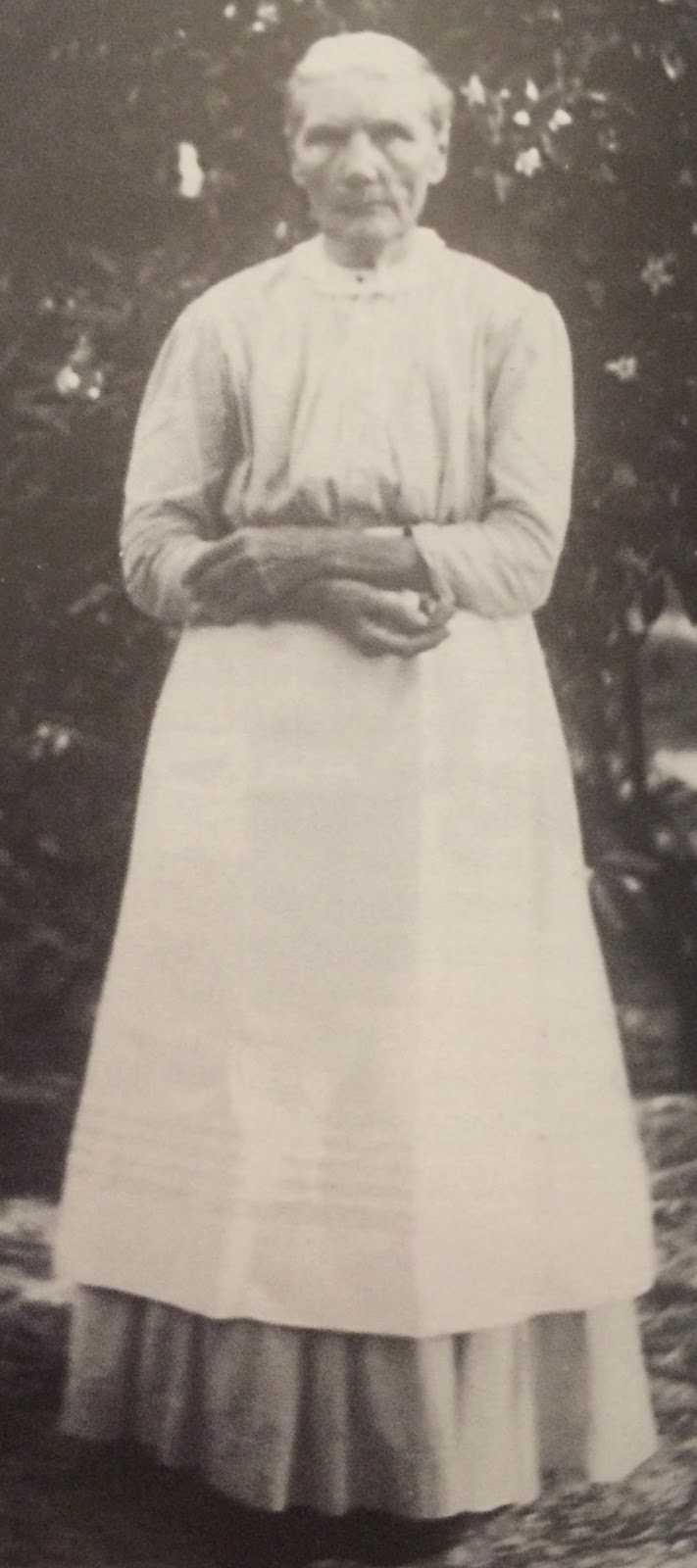
Full-length photo of Florida pioneer Mary Ann Thursby
West Volusia Historical
Society photo of pioneer
Mary Ann Thursby is on
page 8 of Our Story of
Orange  City, Florida

A trailblazer like Mary Ann Thursby dressed to get the job done. She settled at Blue Spring with her husband and children in the mid 1800s. Their nearest neighbor was eight miles away. We're talking wilderness. 

Her story in the fourth edition of Our Story of Orange City, Florida (Village Improvement Association, 2000) includes a picture of her in a no-frills garment, matched by a no-nonsense attitude. But even she put on a clean white apron to pose for the camera.

The Freeman family -- hotelkeepers  -- in another of the book's photos are ready for a different kind of business. The ruffles, tucks, bows, and pleats of the women's outfits speak of starched fabric and hours at the ironing board. Cinched waists tell of the corsets underneath. Every hair is in place - no easy task in our frizz-inducing humidity. The Freeman women are polished and professional as they wait to welcome guests. And the lone man in the photo also appears to be wearing crisp, clean clothing.

Family business activity was acceptable for 19th century women, particularly when based at home. Ladies who went out to work often faced discrimination, low pay and social disapproval. But you wouldn't guess it from a mid-1890s photo of the "women's editors" of the Orange City Times, an early newspaper. 

The editors smirk and smile for the camera. Their attire resembles that of the hotelkeepers in style. But the dresses aren't as starched. Wrinkles can be detected. And the hats are positively frightful. Perhaps they were the height of fashion. Or maybe they hid the frizzy tresses of a crew too busy breaking barriers to style their hair.

End note: You can visit the historic Thursby House at Blue Spring State Park.


19th century photo of family on porch
The Freeman family is poised and professional as they
 wait to greet guests at their hotel. The West Volusia
Historical Society photo is on page 22 of
Our Story of Orange City, Florida.


Monday, December 15, 2014

Hair: The long and short of it

People sitting on porch steps at Leon Hotel, Tallahassee, circa 1886
Notice how the women wear their hair up in this 1880s
 photo of Leon Hotel in Tallahassee. The photo is by
 Alvin S. Harper and appears in Victorian Florida,
 America's Last Frontier
,
 by Floyd and Marion Rinhart

Women today fashion their hair in myriad shapes, styles, lengths, and colors. We take for granted all the options and the ability to choose from among them. 

Contrast that to the late 19th century. Women had one choice for hair length: long. They had one choice for styling: up. Only girls and young women not yet out in society wore their hair in a loose, flowing manner.

The evidence is obvious in old photographs from Florida's frontier years. Every woman, from backwoods denizens to wealthy winter tourists, exhibits swept-up long hair. 

The less wealthy women didn't make a fuss over it. They parted their hair in the middle and twisted it into some kind of bun. Or they pulled it back without any visible part and pinned it atop or behind their head. 

Well-off tourists, meanwhile, displayed fashion trends such as frizzed bangs in the late 1880s. Why anyone would deliberately frizz their hair is beyond me. But that style was a fad for a while.

By the mid 1890s, the small topknot was the height of fashion. Such a style worked well for those with abundant hair. Otherwise, the results could appear comical.

One thing that connects past and present is the amount of time, care, and attention women lavish on their hair. But after reviewing, for example, Mark Campbell's 1867 book, Self-Instructor in the Art of Hair Work, Dressing Hair, Making Curls, Switches, Braids, and Hair Jewelry of Every Description, I give thanks for modern haircare products.

Campbell called his book an "indispensable adjunct to every lady's toilet table." It promised to help a woman dress her own hair and become proficient in the making of hair work. Hair work meant items such as braids, which functioned much the way today's hair extensions do. 

The book's directions are occasionally nightmarish. Even the easiest pattern in Campbell's book calls for the artisan to braid the hair extension over a wire, boil it, place the braided piece in a hot oven - be careful not to burn it! - and then remove the wire, insert a pliable cord in its place, sew the end of the braid together and dab it with a dose of shellac.

You can read the book online on the Project Gutenberg website if you want to learn more. It's also available on Google Books (not Google Play, which is a different Google books site).

More accessible is Dorothy Quigley's 1897 What Dress Makes of Us, also available on Project Gutenberg. She offered readers valuable advice for how to select a hairstyle based on the shape of the face. 

She urges women to do what works for them: "A wise woman will adopt a prevailing mode with discretion, for, what may be essentially appropriate for one, may be fatally inappropriate for another," she wrote. Wise words, that still hold true today.