Tuesday, August 30, 2022

1896 Sears catalog Amazon of its day

screengrab of part of a page about tea, from 1896 Sears catalog
Detail of a page from the 1896 Sears catalog
I stumbled across the 1896 Sears Roebuck catalog on—of all places—Ancestry.com. Of course I proceeded to spend too much time there. 

My main interest lies in how old catalogs depict items used in everyday life. Another reason is the time period. Paging through the catalog digitally reminded me that characters in my novels would have thumbed through the real thing. The 600-plus-page catalog was the Amazon of its day.


My novels are in my mind because I’ve just re-released the Kindle version of Books 1 and 2 in the Persimmon Hollow series. I got the rights back from the publisher, who no longer sells the books. Now I’m scrambling to get them reprinted with new covers. So far, the Kindle versions are available on Amazon. Paperback is coming soon, as well as versions for other ebook platforms.


The characters in my novels live in a late 19th century world. They would have received the Sears catalog in the mail. And even ordered groceries from it. The 1896 catalog included an entire grocery section, much to my surprise. 


It’s like the “everything old is new again” adage. People 125 years ago ordered groceries from home just like people do today. On paper, not online, true. And who knows how the shipments arrived in areas outside regular mail delivery back then. It’s fun to think about.


In addition to groceries and household items, the catalog featured a sizable pharmacy section. All kinds of tinctures, potions, lotions, oils and other ingredients were offered, enough to stock a  pharmaceutical factory. You could even buy laudanum (23 cents for a 2-oz. bottle). 


The pharmacy section’s offerings were a cross between a modern drugstore’s selections and the homeopathic remedies found at health food stores. Except it’s now illegal to purchase some of the ingredients that old catalog sold.


I noticed another indication of the same-but-different mantra. Customers in 1896 could order tea that came from Japan, China, Formosa and Ceylon. People living in the time of my novels would have recognized all four locations. Today, we’re most familiar with Japan and China. Formosa back then was a name associated with the island of Taiwan. Ceylon was the British colonial name of the now-independent country of Sri Lanka. 


Sears particularly touted its Golden Tips Ceylon and Ungalora Ceylon teas as the healthiest, best flavored and most economical of all teas. But customers could choose from among several types of teas. Prices ranged from 19 cents to 51 cents per pound, depending on grade and quantity.


There was no popping a cup of water in the microwave to heat up tea water in those days. If you want to brew tea the way they did in 1896, the catalog shared the following instructions:


“Make it at the table; heat the pot, then pour in water that has just come to a boil (not water that has been boiling for some time), put the tea on top of water, let stand from 2 to 7 minutes and pour into cups or other pot; do not let it stand on leaves as that destroys the delicate flavor so much desired.”


I think I’ll go make myself a cup of tea. With some help from the microwave.


New covers of the 3 Persimmon Hollow novels
Here are the new covers for my novels. 


Wednesday, July 27, 2022

Building the Florida dream

1960s aerial image of early Deltona
Aerial image of early Deltona
I'm expanding the parameters of my blog today. The 1960s in Florida pretty much seem like pioneer history at this point. 

OK, I know, it's a bit far-fetched to write about the 1960s when I describe the blog as having a late 1800s-early 1900s focus. But Florida still wasn't heavily developed in the early 1960s.

One of the most interesting aspects of that decade is the way planned communities took hold in the state. One of the companies that led the movement was the family-owned Mackle Company.

I recalled their influence when my hubby found an amazing 1960s video in which one of the Mackle brothers spoke at length about the company's many initiatives in the state. The video seems to have been filmed in the late 1960s or possibly early 1970s.

Mackle mega-developments have taken some rap over the years. But on this video you'll hear some prescient comments. Frank E. Mackle Jr. predicted water as the resource needing the most careful shepherding. He spoke about the need for what we today call greenbelts and about how the Mackles included parks in their planned communities. 

The Mackles' Florida communities were launched more than half a century ago and today are some of the state's large cities. The one I'm most familiar with is Deltona, as I live near there. The photo with this blog post shows the community when construction was in full boom, in the late 1960s. The empty land at top right helps illustrate the before-and-after. 

Today, Deltona is a city of more than 90,000 residents. It's the most-populous city in the county I live in. My city of residence, founded more than a century earlier in the 1870s, has about 35,000 residents.

The other Mackle communities across the state also mushroomed - Spring Hill, Marco Island and others. Marco Island was the upscale one, but the others offered truly affordable housing.

In the early 1960s, a one-bedroom house with lot included cost just under $7,000 in Deltona. That comes in at about $79,000 in today's dollars. Today's tiny houses in planned communities tend to start somewhere in the $300,000s.

The Mackle-built communities faced growing pains, as you can read in a 1985 Orlando Sentinel* article. But they continued growing. The Mackles did a lot of advertising and public relations, and people responded.

The company even displayed one of their Florida houses at the 1964 World's Fair in New York. I remember. I saw it and walked through it. My eight-year-old self was mightily impressed. Didn't known at the time it was a Mackle house in Deltona. I only saw a bright, airy depiction of the Florida dream. 

That dream is still bringing people today.


Tuesday, June 28, 2022

When gold grew on trees

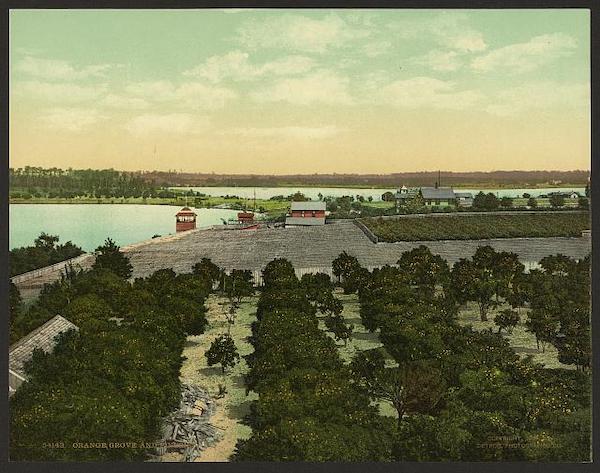
1904 image of an orange grove
A homestead grove in pre-modern Florida
might have looked like this 1904 one.
Credit: Library of Congress
Oranges are on my mind. I just finished reading Florida Oranges, A Colorful History, by Erin Thursby (American Palate, 2019). What a delicious book, pun intended. It's an enjoyable journey that illustrates just how deeply citrus and Florida are intertwined.

One of the hardest things for me to grasp was how much citrus dominated the state and its people in the past. When some people stampeded to the West to strike gold, others flocked to Florida where a different type of gold grew on trees. 

Advice for the Florida bound was plentiful. Books and pamphlets shared all kinds of details. One of these books in my online library is The Florida Settler, published in 1873. It covers more than citrus, but that’s the section I zoomed to. 

Lemons and limes were plentiful and productive in the state at that time. The author says the following about lime production in South Florida: “So profuse is the yield of fruit that in some places the ground is literally covered with it.” (49) Lime juice, the author adds, is “unquestionably the best remedy that can be employed in scurvy.” (49)

But oranges were king, and they grab the most attention of the fruits listed. The author says that, in the two years before the book’s publication - 1872 and 1871 - more than 2 million orange trees were planted in counties that bordered the St. Johns River. 

A person could get in on the action fairly easily. A “man of means” could set up a 10-acre citrus grove for $1,150, a little more than $28,000 today.* The price assumes the grower contracts out all the work. The valuation of the various components boggles me. The land itself - the 10 acres - cost only $25. The inflated worth of that amount is still only about $630 today. Imagine, 10 acres for less than the cost of a new smartphone. You could secure an online loan for that amount in minutes. 

Land clearing is budgeted at far more - $200 for the 10 acres. Breaking the ground after clearing is another $90 and fencing the property also another $90. That $380 amounts to nearly $10,000 today. 

The largest expenditure was $600 for 600 orange trees, each four years old. That’s $1 a tree. It equates to about $25 a tree today. Buying 600 at a time would put a dent in your budget: $600 in 1873 is some $15,000 today. 

Costs for moving and planting the trees were estimated at $100 ($2,500). Let’s not forget a year’s worth of fertilizer: five sacks of Peruvian guano at $9 each, for a total of $45. That would be expensive today - the $9 sacks would each cost $225. But we don’t know how big a sack was in 1873. It had to be large, because only five of them would last a year.

The "Man of Means" price chart is on page 41 of the Florida Settler book. It assumes the best of everything. The author points out that land clearing could be half the estimated account if the foliage wasn’t too thick. Two-year-old trees could be bought for 25 cents each. 

And who needs fences, when, as the author states, “the most successful of the old planters actually herd their cows around the young trees for weeks at a time, and maintain their trees by ‘cow-penning,’ using a fence for the purpose of keeping the cattle in the grove, instead of keeping them out.” (Emphasis included in the original text.)

The author helpfully follows luxury grove expenditures with a plan for those of lesser means. (42) “Cost for a Poor Man” began with free homesteaded land. Out of those 160 acres, 10 acres would be chosen for a grove. Existing trees would be deadened instead of removed, for $4 ($100). This man would raise his hundreds of trees from seed, from an initial outlay of $25 ($630). The biggest costs were for plowing, $50 ($1,260) and for planting and manure, $100 ($2,500). 

In all, the "poor man" could start his grove for $193 ($4,860), less if he did his own plowing, planting and other field work. 

Aside from the hard physical labor, a big difference in the two types of groves showed up in payback. A citrus tree starts to bear fully at about eight years old. The luxury grove would provide good returns in four years. The economy one wouldn’t show a profit for eight years. But it could be done. 

Within a decade, the economy grove would generate revenue between $5,000 ($126,000) and $10,000 a year ($252,000), according to the book. What that man needed most to get started was “patience and industry.” True words even today.

The author based his revenue estimates on the era's long-established groves. The famed Dummitt’s grove on the Indian River yielded 600,000 oranges in 1872. Dummittt earned $11,000 and production and maintenance had only cost $1,000. A grower named Hart in Palatka earned $15,000 to $20,000 a year from his grove, and another grower in Mellonville (now Sanford) earned $12,000 to $15,000 a year. These are all in 1873 dollars. The groves were sized between 1,100 and 3,000 trees.

The author happily noted the lack of problems with citrus, with scale being the most prevalent concern. No citrus canker, and certainly no citrus greening. 

The groves that once blanketed the state are long gone except in South Florida. Even within my lifetime, I remember seeing massive groves in Central Florida, but no more. What the freezes didn’t destroy, bacteria, viruses, and land developments did. 

In other blog posts, I’ve lamented the loss of abundant harvests from my backyard Meyer lemon and Robinson tangerine trees. Greening felled both trees. I’ve got a peach tree in their place now. The fruit is delicious. But it doesn’t say Florida the way citrus does - or did. I’m not sure anything can.

If you enjoy learning about citrus, read both the modern book and the older one. The full, cumbersome title of the 1873 one is: The Florida Settler, or Immigrants’ Guide; A Complete Manual of Information Concerning the Climate, Soils, Products and Resources of the State

Although I’ve cited the author throughout this post, the man who penned the book doesn’t call himself that. The title page says the book was “Prepared by D. Eagan, Commissioner of Lands and Immigration." It was printed in Tallahassee on July 1, 1873. I just realized that means it was printed a year shy of 150 years ago. Such a distant past is hard to conceptualize. So much has changed. But citrus has endured.

Wednesday, May 25, 2022

Give thanks for libraries

Campaign poster featuring 'Stock the Shelves' text atop image of books

2026 update: The Stock the Shelves campaign is no longer active. I removed reference to it  from my author website (gerribauer.com) because the original campaign website has been removed from the internet.The beginning of this post is about the 2022 campaign but the rest of the post is about Florida library history. 

Are you a fan of libraries as I am? They've been part of my life since I learned to read. Right now, Catholic authors and publishers are hosting a Stock the Shelves campaign to encourage readers to ask their local libraries to stock books that reflect Catholic and/or Orthodox perspectives and worldviews. And Lord knows the world needs more of the moral compasses on which those worldviews and perspectives are built. 

The official campaign dates are May 15-June 1, 2022 but I'm going to keep the Stock the Shelves page live on my website. There's no deadline on the idea of adding more good books to libraries.

Working on my campaign webpage made me wonder about the history of libraries in Florida. Superficial research revealed some immediate surprises. The Marion County library website said that two other nearby counties - Levy and Citrus - plus the Marion County city of Ocala formed the Central Florida Regional Library in 1961. That's right, 1961, practically modern times. 

Meanwhile the city of Seminole's website notes that the Seminole Community Library was founded in 1960. Another midcentury America founding. What took so long? What were Floridians doing about libraries in the 1880s, 1890s, and early years of the 1900s? 

My guess is early libraries were small and scattered, hosted in the homes or clubs of civic-minded individuals or set up via subscription. Libraries have to evolve to survive. One look inside a modern facility tells you that. So the Florida library of 100 or 120 years ago must have been vastly different than anything I can imagine. 

I browsed a bit more and was delighted to find a document titled Florida Library History Project - Volusia County Public Library in the University of South Florida's digital collections. Delighted because of what I learned and because Volusia County is the county in which I live. And, because finding that link led me to the entire Florida Library History Project's digital files. These types of discoveries are what make the rabbit hole of research so enticing.

But the first paragraph of the document chilled me. The first sentence says that, before the federal Library Services Act was enacted in the mid-1950s, "libraries were frequently substandard or non-existent, particularly in rural areas." I give thanks to have been born and raised in crowded Brooklyn, N.Y, where libraries were established early and where branches were often within walking distance. I visited my local library every week in the 1960s. And I know my parents did the same in their Brooklyn youths.

I especially appreciated my youthful access when I read the document's next sentence. Before the mid-1950s, in Florida, more than 2 million people had no access to libraries. And only 25 percent of the state's population had adequate access. I could cry at reading that. What did the poor, rural, intelligent child hungry for books and knowledge do?

I had no idea libraries were such latecomers to many scenes. Volusia County's countywide effort began in 1949. The document's explanations about earlier efforts likely mirrors what occurred in other places in Florida. Women's clubs, membership associations, or small municipal reading rooms served as local libraries. Books were often second-hand and donated by the sponsors. 

Go visit your nearby library and be thankful it exists. Join the local Friends of the Library if you can, to support supplemental projects that aren't funded through other means. I love online libraries but nothing beats a browse through the shelves in person. Shrinking though those shelves might be. I realize - as I already said -  that libraries must continue to evolve if they want to continue to exist. I get it. Just have to remind myself sometimes.

But right now, I'll go spend too much time cruising through the Library History Project's online collection. I know it has to be rich in period details about libraries starting small and starting as labors of love and community-mindedness. 

Most - if not all - of today's precious libraries have roots in the hearts and minds of regular people who loved to read, loved to learn, loved books, and loved to help others gain access to the same. For that, we all can give thanks. Support your local library. It's a treasure. And ask them to stock books you'd like to read.

Happy reading!

Friday, April 29, 2022

Melancholy a depressing subject

Detail of Degas painting 'Melancholy'
Detail from 1860s Degas painting titled
'Melancholy.' Credit: Phillips Collection
What pioneers would have called melancholy has been stalking me lately. I've lived on the depression/anxiety spectrum for decades. My condition is controlled but I'm fairly certain it'll never be cured. That's okay. I deal with it. 

At least now, in the 21st century, we can talk about mental health issues. That wasn't done when I was younger. I was told I was sensitive and moody. 

So, if the subject was taboo as recently as my youth - a half century back - what did people do about melancholy in the mid-19th and early 20th centuries? Especially on sparsely settled frontiers?

I hopped over to Project Gutenberg to see what publications of earlier eras might have to say. If you're not familiar with Project Gutenberg and you love old, public-domain books, please get acquainted! You'll be delighted. 

My first perusal predated the years I discuss in this blog. Observations on Madness and Melancholy by John Haslam was published in 1809 in London. The author was an apothecary and a member of the Royal College of Surgeons.

Oddly, the text coupled madness and melancholy. Every chapter and sub-heading was about insanity. Melancholy didn't seem to be a separate topic. 

I left Dr. Haslam's 350-page tome unread after searching for mentions of melancholy and finding only eight, including the one in the title. I searched for other offerings. The Anatomy of Melancholy looked promising. But it turned out to be a 19th century edition of a 1683 book. It, too, contained little about depression. Plus, I couldn't get past the fussy, overwritten prefaces and the frequent use of Latin.

Then I found a gold-mine, an abstract of a 1986 research paper originally written in German. It explained why those early books avoided discussions about depression. Turns out that use of the word melancholy as a euphemism for depression was a fairly recent development - within the last century (dating from the time the paper was written). 

The academic paper featured historical notes about depression therapy. The abstract is short but fascinating. The Arabs had separate wards for mentally struggling patients as far back as the 8th century. Renaissance doctors emphasized the importance of diet for depressed patients. Eggs, meat, fish, and grapes were particularly recommended.

Opium was widely used as treatment in the 19th and into the 20th century. Doctors in the 19th century also relied on many other treatments. Some made sense to my 21st century eyes: baths and massage. Others, not at all: arsenic. You can read the abstract at the National Library of Medicine's website: https://pubmed.ncbi.nlm.nih.gov/3541174/

People in pioneer settings often lacked access to extensive medical care. I like to think they discovered the same self-help ideas I stumbled upon through the years. Exercise, at least in my case, is guaranteed to lift spirits. It's an after-effect. You have to exercise first. Staying busy is a tool in my arsenal. Sunshine helps, too. Lots of sunshine. Gratitude and prayer, too. 

They're not complete answers but they're worth doing along with what doctors recommend. I'm turning my face toward the sun.

Tuesday, March 29, 2022

Health landscape was no picnic

cover of 1989 issue of Florida Journal of Public Health
This journal edition celebrated
the centennial of public health
care in Florida
Family health matters are claiming my time, energy and focus right now. I'm distracted and not thinking about my monthly blog post. But the deadline is here. 

Since health is foremost in my mind, I did a Google search about Florida's health history. I found an interesting Florida Department of Health PDF created in 1989 to mark the centennial of public health care in the state. It's a reprint, with permission, of an article that ran in the Florida Journal of Public Health that same year. 

The author, William J. Bigler, Ph.D., had been with the state health department since the 1950s and had a firm grip on the facts. Some of those facts, though, were scary. 

I like to think about the sunnier side of life in pioneer Florida. Diseases, pests, unsanitary conditions and lack of medical knowledge remind me there were other sides to life. The document's information made me thankful for progress made in healthcare and medical technology since the late 1800s and early 1900s. We've come light years, really. 

Here are some of the issues early Floridians encountered at various times and in various parts of the state: smallpox, yellow fever, dengue fever, tuberculosis, malaria, cholera, typhoid, black plague. The plague struck just once, at least according to records. But that once was in the twentieth century - 1920 to be exact. Yellow fever, on the other hand, terrorized Floridians repeatedly. In one example, the PDF recounts how all but 100 of Fernandina's then-population of 1,600 were infected in 1877. Hundreds of them died. 

And, of course, there was the 1918 influenza pandemic, known at the time as Spanish flu. It lasted a few years, as our COVID one is doing. But they didn't have a vaccine that worked in 1918. In one month alone that year, the death rate was 29 percent. Over a four-month period, it was about 25 percent.

Well, this blog post has certainly been less than cheerful. I'm distracted by family matters and sad about the war victims in Ukraine and weary that yet another COVID variant is rearing its head. At least it's not causing severe illness. I'll take any good news I can get.

If you've a mind to read more, take a look at the documents available on the Florida Health Association's website page devoted to the history of Florida's public health. And be glad we live when we do.

Saturday, February 26, 2022

Sicilian needlework stories wait to be told

detail image of Sicilian embroidery
Detail of a whitework tablecloth that my
 grandmother Rose Russo Puccio

embroidered in the early 1900s.
(Photo credit: Gerri Bauer)

Maybe I'm not looking in the right places. Dig as I might, I find little about the cutwork embroidery and other needlework done by immigrant Sicilian and other Italian women in early 20th century Florida. Yet I know it was being done.

I wonder where those works of art are today. Handed down in families? Or are they the pieces I see for sale on eBay, Facebook and elsewhere online?

The question arose after I recently took out and refolded the family heirloom linens I inherited. My Sicilian immigrant grandmother created them in New York City between 1910 and 1918. In the same era, a sizeable cluster of Sicilian immigrant women lived and worked in Tampa's Ybor City. Information about their role in the city's cigar-making industries is fairly easy to locate. Information about their domestic lives, not so much.

Yet, as historian and USF professor emeritus Gary Mormino pointed out in a 1983 Florida Historical Quarterly article about Ybor City Italian women, it was family - not work - that was the primary focus of these women. That was true even when they worked outside the home.

Everyone labored to ensure the family survived and thrived. In the early 20th century, Sicilian children routinely were pulled from school and sent to work. My grandmother had only a third-grade education. Her counterparts in Florida had similar experiences.

Mormino's article isn't about needlework. But within it, a sentence tells me how much the traditional and cultural Sicilian skill remained an integral part of immigrant life in Ybor City: "While at home, Italian women somehow found time to continue the handicraft arts of sewing, crocheting, and embroidering."

My Sicilian grandmother worked in a sweatshop, yet turned out beautiful embroidered needlework including the piece pictured with this blog. She was from the same region of Sicily as most of the Sicilian women in Ybor City. Needlework was an important part of their lives. It wasn't a hobby as it is today for me. They were making bed and table linens for their trousseaus. They were preparing for future family life.

So, I have a lot of questions. Did these women in Tampa sit and sew together? Did they bring handworks-in-progress to community outings? Did the needlework provide cultural closeness to all they'd left behind? Where did the designs come from? What stores supplied the fabric and thread? Were the materials mailed to the women by relatives? 

Above all, where did all that beautiful cutwork embroidery and other needlework go? I speak of the pieces that were special, not the everyday ones used until threadbare. Some of the fine needlework is artistic and belongs in museums. Is it showcased anywhere?

Traditionally, the finest pieces were handed down. But even that practice is fading. Younger generations aren't as interested in the heirloom linens. Yet each piece has a face, a life, a story behind it. They cry out to be remembered.