Showing posts with label fashion. Show all posts

Tuesday, May 28, 2024

Being fashion-forward in 1894

screengrab of two pages of April 1894 issue of Vogue magazine featuring fashions and hairstyles
Big sleeves and an unusual hairstyle characterized
fashion in 1894 (Credit: Vogue magazine archives)

What a parade of red-carpet fashions we've seen recently. I streamed some, watched some on TV and browsed photos of others - Oscars, Met Gala, Cannes, CMA and on and on. Fun to see. And it made me wonder what passed for prime fashion in Florida's past years. Specifically, during the Gilded Age.

St. Augustine was a trendy winter destination for the elite in that era. The top spot in the city was the Ponce deLeon Hotel, built by mega-rich oil magnate Henry Flagler. So, when Mrs. Henry Flagler hosted an event, local newspapers took notice. Hence the write up in the April 5,1891 issue of "The Tatler," aka the St. Augustine News, "devoted to the interests of Southern winter resorts."

The article was about "a very pretty small dance" given by Mrs. Flagler for a few of her friends in the west wing of the hotel's dining room. (That room is vast - I've been in it.). Alas, the reporter wasn't up on fashion. The women's dresses are variously described as dainty, lovely, handsome and beautiful. Low necklines abounded, as many of the gowns were described as decollete.

A few details can be gleaned from color and fabric mentions: mauve crepe de chine, green crepe de chine, white tulle, pink tulle, yellow tulle. But there's nothing about sleeve styles, embellishments or accessories. 

A number of guests staying at the Ponce headed over to a dance at the Cordova Hotel in  1894, according to The Tatler's issue of April 7, 1894. This article is a bit more descriptive. One young matron wore a "pink-and-white moire gown with a decollete bodice of black velvet and pointe de neige lace bertha (collar) and sleeves." A visitor from New York wore a gown of "black lace with many rows of garnet velvet (and) velvet sleeves." 

Sleeves were an item in 1894. Illustrations in Vogue magazine's April 5, 1894 issue make that clear. Sleeves were large, very large, and loud. An odd (to me) hairstyle also was popular that year. Look at the blobs of hair atop the center of the women's heads in the left side of the image at the top of this post. Then, as now, some fashions were way over the top.

Screengrab from April 1894 issue of Vogue magazine featuring illustrations of women's fashions
Puffy sleeves and skirts
starred in 1894 fashion. (Credit:
 Vogue magazine archive)

Tuesday, September 27, 2022

Cheap fabric and oversized sleeves

screengrab of 2 fashion pages from 1896 Sears catalog
The seamstress heroine of my 2nd novel
was too fashionable to fall for this trend
I spent so much time paging through an online 
1896 Sears Roebuck catalog that I gathered enough for two blog posts.

Last month, we looked at the catalog's grocery section. Today I'm focused on the fabric department.

Both posts connect to how the characters in my Persimmon Hollow novels would have been familiar with Sears catalogs. I've just reprinted Books 1 and 2 with a new publisher and new covers that fit the theme of Book 3's cover. 

The novels are set in the late 1800s. Fast fashion as we know it today didn't exist in 1896 pioneer Florida. Yes, a person could buy ready-to-wear clothing in stores and from catalogs. But each item was purchased with an eye toward longevity. Most women and probably a lot of men knew how to sew and make garments. They spent quite a bit of time doing so. Far more than today. 

The heroine of my second novel is a seamstress named Josefa. She perfects her craft through an apprenticeship with the town dressmaker. Any author will tell you their characters seem like real people to them. I'm no exception. I can imagine Josefa poring over the fabric selections of the Sears catalog.

The section wasn't named "Fabric." No, it was the Dress Goods Department. It started on page 136, right after a page selling cheese box machines and creamery butter tubs.

Dress Goods depicted “all the newest and choicest products of foreign and domestic looms for the fall and winter season of 1897.” That wasn't all. There also was material touted as year-round fabric and a promise that “all the popular new up-to-date fancy brocades, Jacquards, two toned effects” were always in stock in great variety.

The prices almost made me swoon. A two-color diamond pattern brocade sold for 11 cents a yard. A wool serge was 25 cents yard and scotch wool plaid 29 cents.

Silk was an uptown price, hovering at 98 cents a yard, while soft, fleecy flannel went for 6 and 3/4 cents a yard. If you wanted basic, unbleached cotton flannel, you could have it for 4 cents a yard. Gingham was slightly more expensive: 4 and 1/2 cents a yard. Percales were double that price, or 9 cents a yard.Don't ask me how they figured change when dealing with half- and quarter-cent pricing.

My astonishment grew as I reached the pages that advertised quilts. One seven-pound bed quilt measured 72x78 inches. It was made of twilled sateen, red lining and carded cotton fill and it featured something called "fancy quilting." The price was...are you ready...$1.50. I searched to discover the equivalent of that price in purchasing power today. The result: $52.91.

Seamstress Josefa would definitely have spent time perusing the quilts, household linens and ready-to-wear sections of the catalog. She would have looked for fashion trends, judged the latest styles and determined what would and wouldn't work in her frontier Florida environment of Persimmon Hollow.

One fashion at the peak of popularity at that time was the ridiculous bubble sleeve that puffed out four or five times the width of the wearer’s arm. I’d have skipped that trend had I lived back then. Just like I skipped the whole cold-shoulder blouse trend of recent years.

My seamstress heroine had better fashion sense than to wear those massive winglike sleeves. She had style and taste. Of that I'm sure. I know her pretty well. :) 

Friday, April 14, 2017

Heavy music on a joyous day

screengrab of ad for Easter clothes, from 1916 newspaper
This ad appeared on the same page of the
April 21, 1916 Pensacola Journal as the
article about Easter music at St. Michael's.
Catholics tend to fall into two camps when it comes to church music - traditional or contemporary. Me, I like Gregorian chant. Some was performed at Easter services at St. Michael's in Pensacola a century ago. Along with a great deal of other music.

First, a digression. In case you're wondering why the blog illustration depicts Easter finery instead of something music-related. I had nothing to accompany the musical selections listed below, is one reason. The other is that the illustration appears on the same newspaper page as the article about the St. Michael's Easter service. Both are on Page 3 of the April 21, 1916 edition of the Pensacola Journal. At first glance, I thought I was looking at 1950s fashions. I rechecked the newspaper date, and sure enough it's 1916.

Pensacola has many strengths but it's hardly a hotbed of fashion forwardness. I'm intrigued enough to add women's fashion trends of the 19-teen years to my "future explorations" file.

Back to the music. The newspaper reporter said the choir "prepared a brilliant musical program for its part in the divine services Easter Sunday." The music was set to begin a half-hour before solemn High Mass. Another performance was scheduled for Easter evening, and the entire community was invited, including non-Catholics. The article makes a point of noting that fact. A crowd was expected, and extra chairs brought in.

Here's the musical program:

  • Vidi Aquam (Gregorian)
  • Regina Coeli (Giorza)
  • Kyrie (Emerson)
  • Gloria (Ganns)
  • Credo (Ganns)
  • Sanctus (Emerson)
  • Benedictus (Gounod)
  • “Pilgrims’ Chorus” and “Evening Star” from Tannhauser (Wagner)
  • “Sweet Reverie” (Tobani-Getz)
  • “As God Ordained,” quartet for strongs (strings?) (Muted)
  • “Largo” (Handel)
  • Postlude, “The Heavens Are Telling” (Handel)
Instruments were five violins, a cornet, flute, cello, bass, clarinet and organ. The musicians were mentioned by name. The violinists were O’Brien Motto, Bertram Coleman, Bertram Dannheisser, Max Heinberg and Fred Fairchild. On the cornet was Robert Diaz, with A. Distasia on flute, A. Diaz on cello, Benj. Fairchild on bass, a Mr. Brown on clarinet and A.C. Reilly as organist. No word on individual members of the chorus. Perhaps too many to list. The congregation was expected to sing even at the evening program.

The performances at the church were said to be the continuance of a "time-honored custom." St. Michael's in 1916 was already a historic parish, having been established in 1781. Today, St. Michael's is a basilica.

After reading such a glowing write-up, I dug up renditions on YouTube of several of the selections. Oh, my. Just about all were quite heavy. Much has changed in Catholic church music over the last century. For the better.

Wednesday, April 22, 2015

Dressed for success

photo of group of women taken in  late 19th century
These professional ladies were called "women's editors."
This Orange City Library Association photo appears on
page 57 of
Our Story of Orange City, Florida 

The heroine of my work-in-progress (Stitching a Life in Persimmon Hollow) is a skilled seamstress and 19th century fashionista. Or as much a fashionista as one could be in a pioneer town several hours from urban civilization. So, lately, I've been thinking a lot about how women dressed in frontier Florida.

Then, as now, the range is vast. Our perspective is distorted because people donned their best for photo-making sessions in the early days. Even so, we can note interesting distinctions by looking at a few photos, shared here.

Full-length photo of Florida pioneer Mary Ann Thursby
West Volusia Historical
Society photo of pioneer
Mary Ann Thursby is on
page 8 of Our Story of
Orange  City, Florida

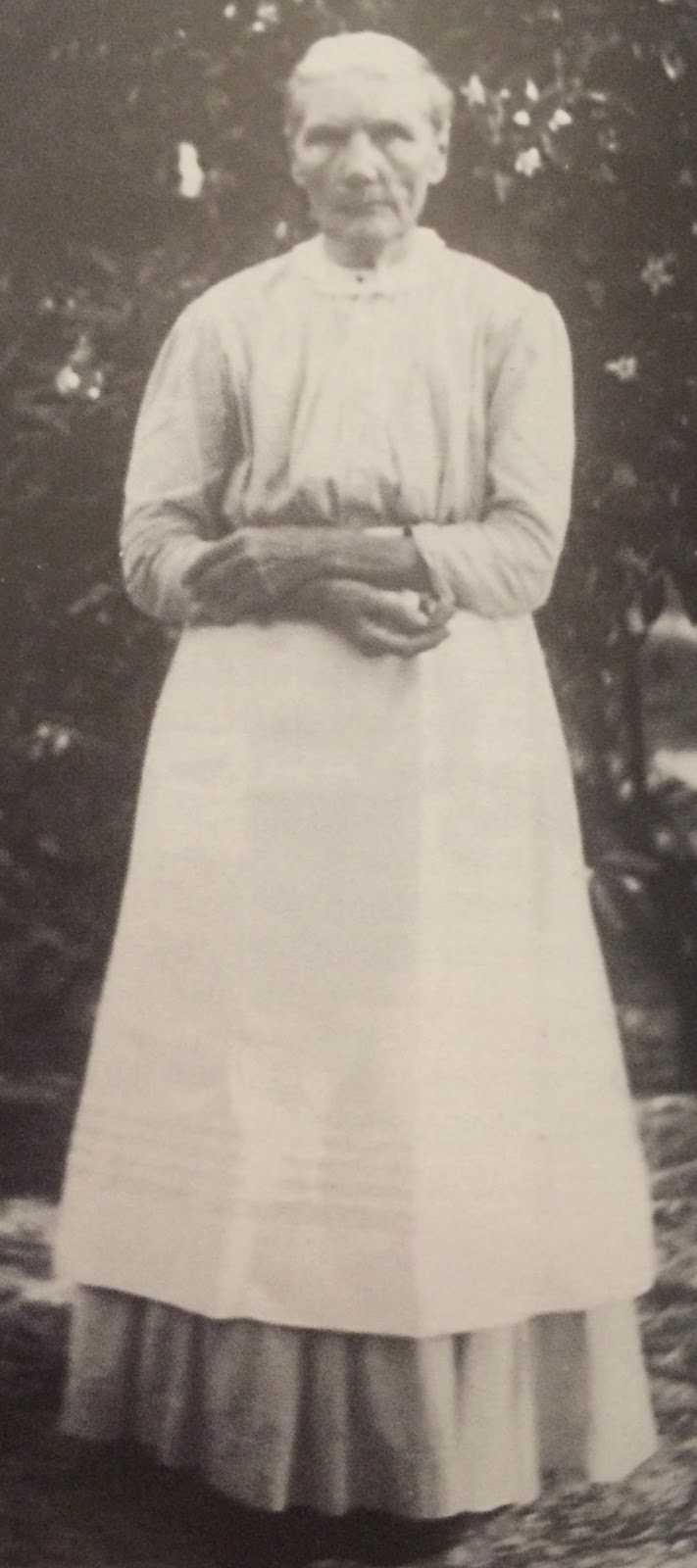
A trailblazer like Mary Ann Thursby dressed to get the job done. She settled at Blue Spring with her husband and children in the mid 1800s. Their nearest neighbor was eight miles away. We're talking wilderness. 

Her story in the fourth edition of Our Story of Orange City, Florida (Village Improvement Association, 2000) includes a picture of her in a no-frills garment, matched by a no-nonsense attitude. But even she put on a clean white apron to pose for the camera.

The Freeman family -- hotelkeepers  -- in another of the book's photos are ready for a different kind of business. The ruffles, tucks, bows, and pleats of the women's outfits speak of starched fabric and hours at the ironing board. Cinched waists tell of the corsets underneath. Every hair is in place - no easy task in our frizz-inducing humidity. The Freeman women are polished and professional as they wait to welcome guests. And the lone man in the photo also appears to be wearing crisp, clean clothing.

Family business activity was acceptable for 19th century women, particularly when based at home. Ladies who went out to work often faced discrimination, low pay and social disapproval. But you wouldn't guess it from a mid-1890s photo of the "women's editors" of the Orange City Times, an early newspaper. 

The editors smirk and smile for the camera. Their attire resembles that of the hotelkeepers in style. But the dresses aren't as starched. Wrinkles can be detected. And the hats are positively frightful. Perhaps they were the height of fashion. Or maybe they hid the frizzy tresses of a crew too busy breaking barriers to style their hair.

End note: You can visit the historic Thursby House at Blue Spring State Park.


19th century photo of family on porch
The Freeman family is poised and professional as they
 wait to greet guests at their hotel. The West Volusia
Historical Society photo is on page 22 of
Our Story of Orange City, Florida.


Monday, December 15, 2014

Hair: The long and short of it

People sitting on porch steps at Leon Hotel, Tallahassee, circa 1886
Notice how the women wear their hair up in this 1880s
 photo of Leon Hotel in Tallahassee. The photo is by
 Alvin S. Harper and appears in Victorian Florida,
 America's Last Frontier
,
 by Floyd and Marion Rinhart

Women today fashion their hair in myriad shapes, styles, lengths, and colors. We take for granted all the options and the ability to choose from among them. 

Contrast that to the late 19th century. Women had one choice for hair length: long. They had one choice for styling: up. Only girls and young women not yet out in society wore their hair in a loose, flowing manner.

The evidence is obvious in old photographs from Florida's frontier years. Every woman, from backwoods denizens to wealthy winter tourists, exhibits swept-up long hair. 

The less wealthy women didn't make a fuss over it. They parted their hair in the middle and twisted it into some kind of bun. Or they pulled it back without any visible part and pinned it atop or behind their head. 

Well-off tourists, meanwhile, displayed fashion trends such as frizzed bangs in the late 1880s. Why anyone would deliberately frizz their hair is beyond me. But that style was a fad for a while.

By the mid 1890s, the small topknot was the height of fashion. Such a style worked well for those with abundant hair. Otherwise, the results could appear comical.

One thing that connects past and present is the amount of time, care, and attention women lavish on their hair. But after reviewing, for example, Mark Campbell's 1867 book, Self-Instructor in the Art of Hair Work, Dressing Hair, Making Curls, Switches, Braids, and Hair Jewelry of Every Description, I give thanks for modern haircare products.

Campbell called his book an "indispensable adjunct to every lady's toilet table." It promised to help a woman dress her own hair and become proficient in the making of hair work. Hair work meant items such as braids, which functioned much the way today's hair extensions do. 

The book's directions are occasionally nightmarish. Even the easiest pattern in Campbell's book calls for the artisan to braid the hair extension over a wire, boil it, place the braided piece in a hot oven - be careful not to burn it! - and then remove the wire, insert a pliable cord in its place, sew the end of the braid together and dab it with a dose of shellac.

You can read the book online on the Project Gutenberg website if you want to learn more. It's also available on Google Books (not Google Play, which is a different Google books site).

More accessible is Dorothy Quigley's 1897 What Dress Makes of Us, also available on Project Gutenberg. She offered readers valuable advice for how to select a hairstyle based on the shape of the face. 

She urges women to do what works for them: "A wise woman will adopt a prevailing mode with discretion, for, what may be essentially appropriate for one, may be fatally inappropriate for another," she wrote. Wise words, that still hold true today.