Showing posts with label pioneer. Show all posts

Saturday, June 28, 2025

Wilderness hospitality

Museum view of Pacetti Hotel bedroom furnished as in the late 1800s
Guest bedroom is furnished as it would have
been in the late 1800s. (Gerri Bauer photo)

Trading, fishing, guiding visitors - they were some of the ways pioneers in undeveloped parts of Florida made their living in the late 1800s. The Pacetti family of Ponce Inlet did so, and more, at a time when the area was a true wilderness.

Even the Ponce Inlet Lighthouse didn't exist at first. Bartolo and Martha Pacetti sold 10 acres to the U.S. government for use as a light station. The Ponce Inlet Lighthouse was constructed in 1887.

By that time, the Pacettis operated a thriving fishing resort and boarding house adjacent to the lighthouse grounds. They'd built the structure in 1881 using the $400 earned from the land sale. It was an upgrade from the wooden cottage that had already become known for Pacetti hospitality.

In a joyful moment for history seekers, the restored Pacetti Hotel re-opened in 2024 as a public museum owned by the Ponce DeLeon Inlet Lighthouse Preservation Association. I recently toured the hotel and enjoyed every minute.

Exterior view of restored Pacetti Hotel
The Pacetti Hotel is now a public museum.
(Gerri Bauer photo)

There's a lot of history packed into the building, now named the Constance D. Hunter Historic Pacetti Hotel. And several people worth noting, from modern times to the past:

  • Constance Hunter, whose foundation partially funded the recent restoration
  • The Gamble family of Procter & Gamble fame. Olive Gamble did the first restoration. She and subsequent relatives hosted family and friends there.
  • Fishing and hunting guide and building caretaker Jesse Linzy, who lived at the hotel and worked for the Pacettis starting in 1907. In the 1930s, he married "Miss Ida," the personal cook and maid who arrived with Olive Gamble. In the short-sighted ways of the era, we don't know her surname before she became Ida Linzy.
Each person deserves a blog post but today's belongs to the Pacettis. 

Bartolomeu Clemente Pacetti was born about 1823. He was a descendent of the Pons and Pacetti families who were part of the ill-fated Turnbull Colony (1760s-1770s) in nearby New Smyrna Beach. The colonists arrived from Minorca, Greece and Italy as indentured servants. Most went north to St. Augustine when the colony collapsed, but others stayed nearby. Bartolo inherited some of the Pons family land.

Martha Jane Wickwire Pacetti was born in Florida in 1844 to pioneers from Vermont and Georgia. Her local roots also ran deep. Her ancestors included the Osteen family, whose name lives today in the Florida community of the same name in Volusia County. 

The Pacettis had five children. The family lived and ran their popular resort in a beautiful, bountiful waterfront location. But it was isolated. And the living wasn't easy in the 1880s, 1890s and early 1900s. It was nonstop work, as you learn from museum exhibits. 

Martha gained a reputation as an excellent cook of the fish and wild game the land and sea produced. One visitor said she set a "capital table" and was said to be the best fish cook in Florida. Bartolo, his sons Gomez and Bert (who later became a federal wildlife officer), along with Jesse, became renowned as guides. 

View of Ponce Inlet Lighthouse through a window
The Ponce Inlet Lighthouse
is seen through a window in
Pacetti Hotel. (Gerri Bauer photo)

As the years continued, notables such as businessman James Norris Gamble and artist William Aiken Walker found their way to the resort, along with many others. They included the lighthouse builders, its keepers and their families.

Today, visitors can tour the beautifully restored building and view bedrooms furnished as they were in the different time periods. They can immerse themselves in period details shown in exhibits and explained in wall board displays that include period photos. A short video acquaints guests with the property's history. You can even rent the facility for weddings and other events. Learn more at www.ponceinlet.org

Go see the hotel. And the lighthouse complex, which I'll write about next month. They are both so worth it.

Side view of Pacetti Hotel museum
Side view of the waterfront hotel.
(Gerri Bauer photo)

Monday, November 28, 2016

Cracker architecture a native style

photo of 1912 Cracker-style house at Manatee Village Historical Park
 Old Settler's House in Bradenton is part of
Manatee Village Historical Park: 
https://www.manateevillage.org. The 1912
house has been called Cracker Gothic in style
.

The calendar says November, but everyone in Florida knows late autumn can have as many toasty days as cool ones. 

Warm weather is year-round here. That's one reason for the development of the vernacular architectural style known as Florida Cracker. Such homes were designed to fit within their environment and help residents live comfortably in a challenging climate.

The word Cracker as it applies in Florida can refer to a lifestyle, customs, group of people, food, and, yes, architecture. It's the style of building constructed by many pioneer settlers. 

Cracker houses were wood-frame structures that made use of  Florida's abundant natural resources. Heart pine was particularly durable and readily available in the longleaf pine forests that blanketed the state years ago.

The houses almost without exception featured long, deep porches with extended roofs. Some buildings had detached kitchens to prevent fire and heat from affecting other rooms. And some houses featured what was known as a dog trot. A dog trot was an open passageway situated at the center of the house. The passageway was covered by the roof and porch, and interior rooms opened onto it. The design helped air flow through.

To learn about Cracker architecture from an expert, I recommend you read Classic Cracker, Florida's Wood-Frame Vernacular Architecture, a 1992 Pineapple Press book by architect Ronald W. Haase. The book is informative and filled with photos. This Google page can direct you to copies of it: https://books.google.com/books/about/Classic_Cracker.html?id=F2iHk9pHNxwC

Living-history museums throughout Florida feature restored Cracker homesteads open for tours and self-guided visits. Until you have time to walk through one yourself, enjoy watching this video from the History of Central Florida Podcast Series: https://stars.library.ucf.edu/ahistoryofcentralfloridapodcast/15/

Photo of a Florida Cracker style house
This dwelling is shown in the History
of Central Florida podcast's video:
https://www.youtube.com/watch?v=FHsqSq2XF5M

Wednesday, April 29, 2015

Persimmon Hollow: What's in a name?

Historic photo of downtown DeLand in the early 1880s
The Wild West? No, early DeLand. This view from 1882
shows the corner of Indiana Avenue and Woodland Boulevard.
(Credit: Volusia: The West Side)
Before saleratus manufacturer Henry A. DeLand arrived from New York in 1876 to create an "Athens of Florida," and before his settlement became the City of DeLand in 1882, the area was known as Persimmon Hollow. 

The name has a quaint quality that appeals. My entire historical Catholic romance series, Persimmon Hollow Legacy, is built around a town of that name (yes, that is a shameless plug). A DeLand-based craft brewer, Persimmon Hollow Brewing Co., adopted the moniker (not a shameless plug; I'm more of a wine drinker, but I do like to support local businesses). Otherwise, vestiges of the early name are slim to none, locally.

Several years ago, when I purchased domain names for future use for my novels, persimmonhollow.com was already taken. I was able to get persimmon-hollow.com and persimmonhollow.info. (2022 update: I no longer own them.) That first URL belonged to a boutique store in, of all places, Oklahoma. (2022  update: URL no longer works.) There's also a Persimmon Hollow Village venue center, also in Oklahoma. Its website describes it as a collection of stores grouped together to resemble an "1880s Western Village."

DeLand once looked like an 1880s Western village, a real one. You need only view the West Volusia Historical Society photo that accompanies this post to get the idea. The 1882 view of DeLand shows the downtown corner of Indiana Avenue and Woodland Boulevard, looking west. The image appears on page 243 of the historical society's 1986 book about local history, Volusia: The West Side, edited by William J. Dreggors, John Stephen Hess, and S. Dick Johnston.

One of the book's chapters is titled Persimmon Hollow. However, the clue to the origin of the region's early name is found in the previous chapter. It's the best explanation I've yet come across. The book's authors attribute the history to a man named "Hugh Vernon Bracey, who came to Beresford with his father in 1870" (page 237). Hugh reportedly explained Persimmon Hollow as:
...a place where the spring water caused wild persimmons to grow in abundance. When the fruit ripened, deer, quail and other wild animals would gather there to feed ... It was one of the prime hunting spots of the few adventurous souls who had settled here at that time ... (237)
What an idyllic verbal portrait, marred for my 21st century sensitivities by the mention of hunters. I do understand that homesteaders in 1870s Florida hunted as a means of survival, not for sport. That would come closer to the turn of the 20th century, when tourists slaughtered our wildlife just because they could, and locals decimated bird rookeries so society matrons could decorate their hats with feathers.

I digress. DeLand today doesn't have a spring, and wild persimmons aren't common - at least not in my part of town. Springs bubble to the north -  DeLeon Springs in the eponymous town - and to the south - Blue Spring in Orange City, Green Springs in Enterprise, and Gemini Springs in DeBary. The closest is eight miles from my home, the farthest is 20 miles away. They're all beautiful. 

That doesn't mean an equally jewel-like pool of water never existed in or near the heart of DeLand. Perhaps one did 150 years ago. Maybe it was closer to Lake Beresford, out by the St. Johns River about five miles from downtown. In the mid-1800s, settlers homesteaded in the Beresford area because the river was the main highway at the time. 

The allure of the name Persimmon Hollow lingers, despite the coldness of the trail. As with some mythical Shangri-La, we cling to what we can of a place none of us has ever seen.

Wednesday, April 22, 2015

Dressed for success

photo of group of women taken in  late 19th century
These professional ladies were called "women's editors."
This Orange City Library Association photo appears on
page 57 of
Our Story of Orange City, Florida 

The heroine of my work-in-progress (Stitching a Life in Persimmon Hollow) is a skilled seamstress and 19th century fashionista. Or as much a fashionista as one could be in a pioneer town several hours from urban civilization. So, lately, I've been thinking a lot about how women dressed in frontier Florida.

Then, as now, the range is vast. Our perspective is distorted because people donned their best for photo-making sessions in the early days. Even so, we can note interesting distinctions by looking at a few photos, shared here.

Full-length photo of Florida pioneer Mary Ann Thursby
West Volusia Historical
Society photo of pioneer
Mary Ann Thursby is on
page 8 of Our Story of
Orange  City, Florida

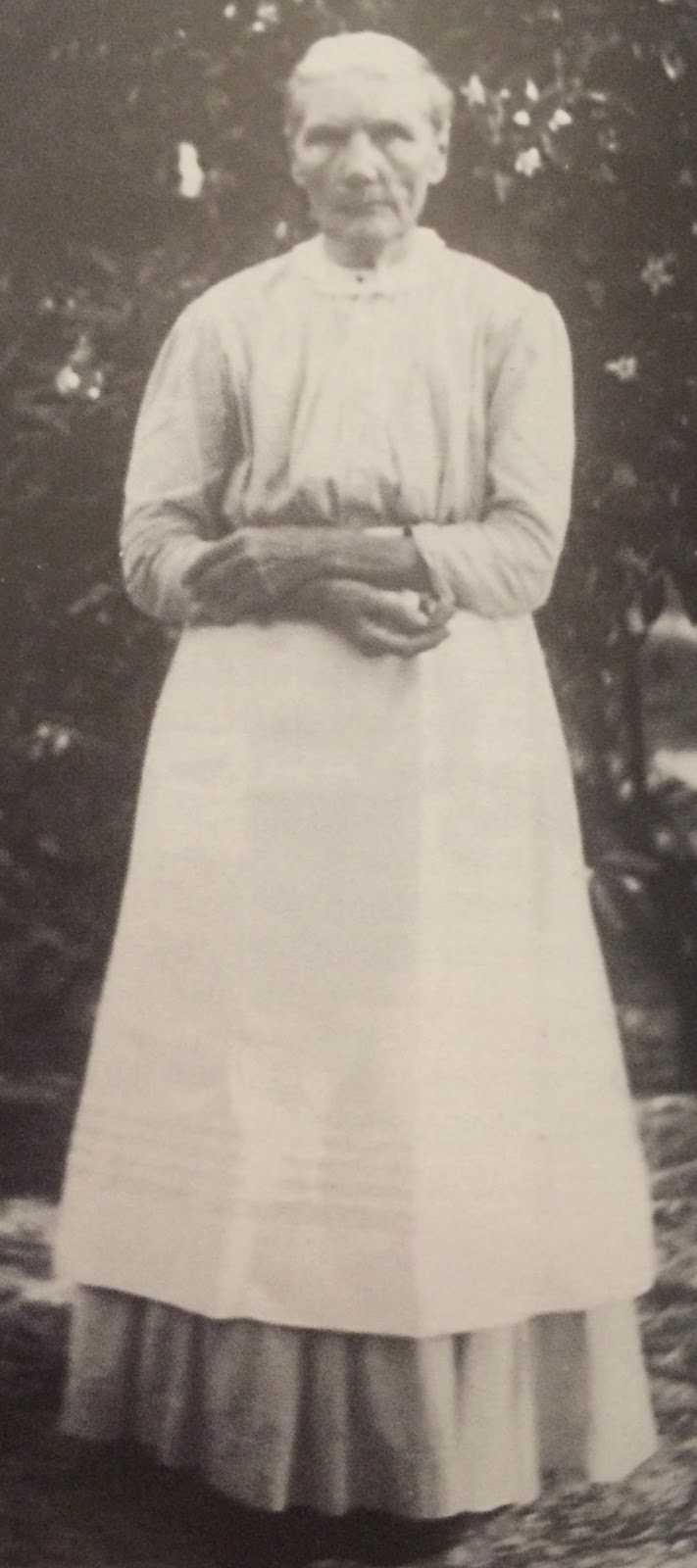
A trailblazer like Mary Ann Thursby dressed to get the job done. She settled at Blue Spring with her husband and children in the mid 1800s. Their nearest neighbor was eight miles away. We're talking wilderness. 

Her story in the fourth edition of Our Story of Orange City, Florida (Village Improvement Association, 2000) includes a picture of her in a no-frills garment, matched by a no-nonsense attitude. But even she put on a clean white apron to pose for the camera.

The Freeman family -- hotelkeepers  -- in another of the book's photos are ready for a different kind of business. The ruffles, tucks, bows, and pleats of the women's outfits speak of starched fabric and hours at the ironing board. Cinched waists tell of the corsets underneath. Every hair is in place - no easy task in our frizz-inducing humidity. The Freeman women are polished and professional as they wait to welcome guests. And the lone man in the photo also appears to be wearing crisp, clean clothing.

Family business activity was acceptable for 19th century women, particularly when based at home. Ladies who went out to work often faced discrimination, low pay and social disapproval. But you wouldn't guess it from a mid-1890s photo of the "women's editors" of the Orange City Times, an early newspaper. 

The editors smirk and smile for the camera. Their attire resembles that of the hotelkeepers in style. But the dresses aren't as starched. Wrinkles can be detected. And the hats are positively frightful. Perhaps they were the height of fashion. Or maybe they hid the frizzy tresses of a crew too busy breaking barriers to style their hair.

End note: You can visit the historic Thursby House at Blue Spring State Park.


19th century photo of family on porch
The Freeman family is poised and professional as they
 wait to greet guests at their hotel. The West Volusia
Historical Society photo is on page 22 of
Our Story of Orange City, Florida.


Friday, June 20, 2014

Pedaling the faith

A big thanks to archivist Sister Catherine Bitzer and the Archives of the Diocese of St. Augustine, for material she shared about Catholic life on the frontier. The information in Brief History of the Churches of the Diocese of St. Augustine Florida stretches the boundaries of my 19th century focus by up to eight years, but is too interesting to overlook.

St. Peter, 1908. Archives of the Diocese of St. Augustine
At the turn of the 20th century, a chunk of land 100 miles by 40 miles comprised Florida East Coast mission field. The Rev. Michael J. Curley covered the area by bicycle and rail. Fr. Curley was the first resident pastor of St. Peter's in DeLand, which was without a resident pastor from 1883 to the early 1900s. (Yes, St. Peter is my parish and I know my first two Pioneer Catholic posts are related to it. I'll expand soon!)

It's hard to think about Florida - fourth most populous U.S. state - as once being mission territory. But the archival literature references Fr. Curley as a missionary priest who pedaled and pushed his bicycle for hours from DeLand to New Smyrna, where he got on the train. That's a good 20 to 25 miles. He then pedaled some more, between stations along the coast.

Clergy were spread thin in frontier Florida, and persevered amid challenges. There wasn't a resident priest from Daytona south to Palm Beach. The Rev. Michael F. Foley of Baltimore spent a good portion of 1885 to 1893 ministering to DeLand and surrounding areas, despite being in "broken-down health." After he left, the Rev. John O'Brien of Palatka came to DeLand once a month to offer Mass. Fr. Curley arrived in 1904.  A diocesan missionary priest named the Rev. P.J. Bresnahan helped spread the Gospel in "DeLand's vast mission field," as the entire Central East area was called, but I'm not sure how long he stayed after his 1906 efforts. Fr. Curley, described as zealous, devoted the second Sunday of each month to the missions.

Concurrent with mission work, a structured worship schedule took form in the growing DeLand parish. Here's a look at the program in about 1906:
  • Sundays, November to May:  High Mass with sermon in morning; Rosary, sermon, Benediction of the Blessed Sacrament in the evening
  • Sundays, June to October: Low Mass with sermon, followed by Benediction, in morning
  • Way of the Cross on Fridays in Lent
  • First Friday "faithfully observed"
  • Sunday School "never omitted"
By this time, 20+ years had passed since Catholics and non-Catholics in DeLand worked together to build and furnish St Peter's Church. They did it again,  in 1906-1908, to erect a rectory and enlarge the church.  Brief History states with pleasure that "... many non-Catholics contributed very generously." The South hasn't always been kind to Catholicism. The good feeling of the ecumenism lingers across the decades.