Showing posts with label style. Show all posts

Wednesday, April 22, 2015

Dressed for success

photo of group of women taken in  late 19th century
These professional ladies were called "women's editors."
This Orange City Library Association photo appears on
page 57 of
Our Story of Orange City, Florida 

The heroine of my work-in-progress (Stitching a Life in Persimmon Hollow) is a skilled seamstress and 19th century fashionista. Or as much a fashionista as one could be in a pioneer town several hours from urban civilization. So, lately, I've been thinking a lot about how women dressed in frontier Florida.

Then, as now, the range is vast. Our perspective is distorted because people donned their best for photo-making sessions in the early days. Even so, we can note interesting distinctions by looking at a few photos, shared here.
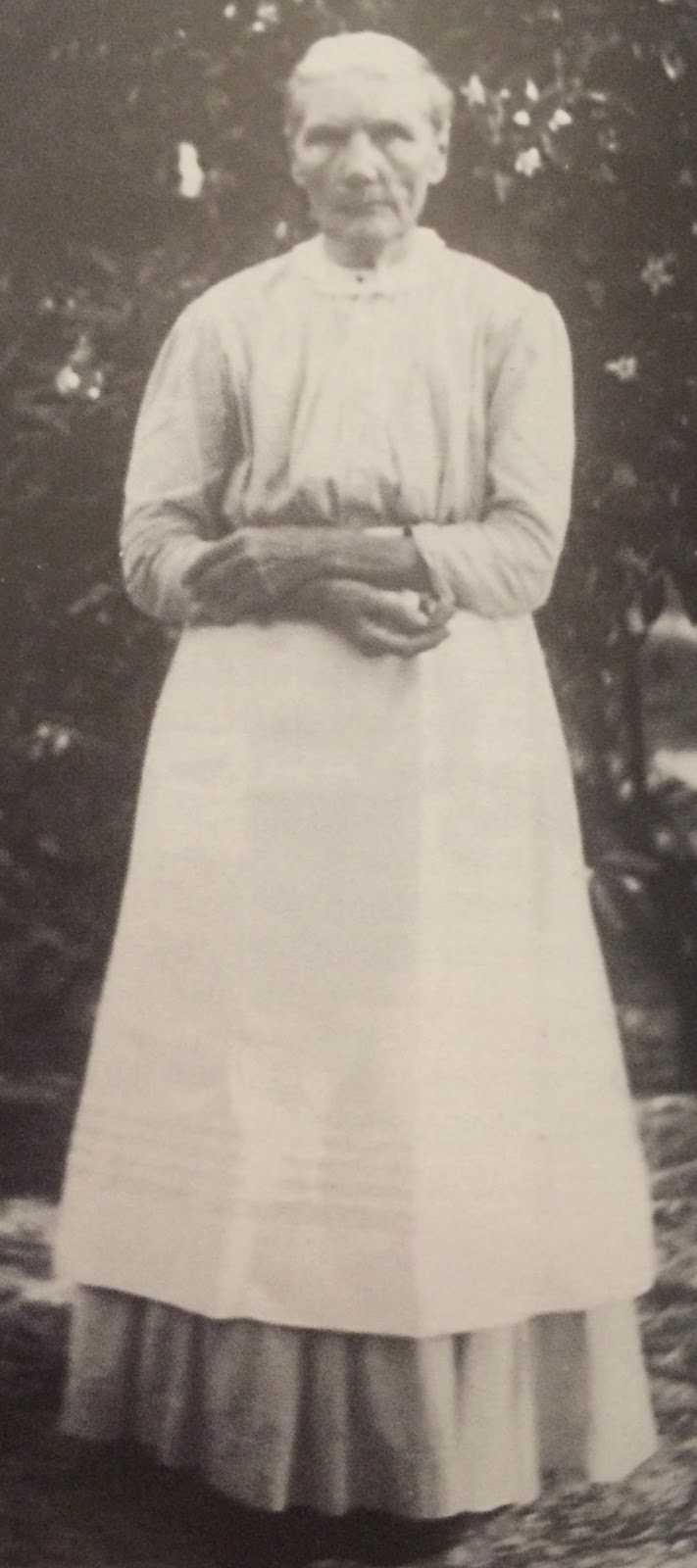
Full-length photo of Florida pioneer Mary Ann Thursby
West Volusia Historical
Society photo of pioneer
Mary Ann Thursby is on
page 8 of Our Story of
Orange  City, Florida

A trailblazer like Mary Ann Thursby dressed to get the job done. She settled at Blue Spring with her husband and children in the mid 1800s. Their nearest neighbor was eight miles away. We're talking wilderness. 

Her story in the fourth edition of Our Story of Orange City, Florida (Village Improvement Association, 2000) includes a picture of her in a no-frills garment, matched by a no-nonsense attitude. But even she put on a clean white apron to pose for the camera.

The Freeman family -- hotelkeepers  -- in another of the book's photos are ready for a different kind of business. The ruffles, tucks, bows, and pleats of the women's outfits speak of starched fabric and hours at the ironing board. Cinched waists tell of the corsets underneath. Every hair is in place - no easy task in our frizz-inducing humidity. The Freeman women are polished and professional as they wait to welcome guests. And the lone man in the photo also appears to be wearing crisp, clean clothing.

Family business activity was acceptable for 19th century women, particularly when based at home. Ladies who went out to work often faced discrimination, low pay and social disapproval. But you wouldn't guess it from a mid-1890s photo of the "women's editors" of the Orange City Times, an early newspaper. 

The editors smirk and smile for the camera. Their attire resembles that of the hotelkeepers in style. But the dresses aren't as starched. Wrinkles can be detected. And the hats are positively frightful. Perhaps they were the height of fashion. Or maybe they hid the frizzy tresses of a crew too busy breaking barriers to style their hair.

End note: You can visit the historic Thursby House at Blue Spring State Park.


19th century photo of family on porch
The Freeman family is poised and professional as they
 wait to greet guests at their hotel. The West Volusia
Historical Society photo is on page 22 of
Our Story of Orange City, Florida.


Monday, December 15, 2014

Hair: The long and short of it

People sitting on porch steps at Leon Hotel, Tallahassee, circa 1886
Notice how the women wear their hair up in this 1880s
 photo of Leon Hotel in Tallahassee. The photo is by
 Alvin S. Harper and appears in Victorian Florida,
 America's Last Frontier
,
 by Floyd and Marion Rinhart

Women today fashion their hair in myriad shapes, styles, lengths, and colors. We take for granted all the options and the ability to choose from among them. 

Contrast that to the late 19th century. Women had one choice for hair length: long. They had one choice for styling: up. Only girls and young women not yet out in society wore their hair in a loose, flowing manner.

The evidence is obvious in old photographs from Florida's frontier years. Every woman, from backwoods denizens to wealthy winter tourists, exhibits swept-up long hair. 

The less wealthy women didn't make a fuss over it. They parted their hair in the middle and twisted it into some kind of bun. Or they pulled it back without any visible part and pinned it atop or behind their head. 

Well-off tourists, meanwhile, displayed fashion trends such as frizzed bangs in the late 1880s. Why anyone would deliberately frizz their hair is beyond me. But that style was a fad for a while.

By the mid 1890s, the small topknot was the height of fashion. Such a style worked well for those with abundant hair. Otherwise, the results could appear comical.

One thing that connects past and present is the amount of time, care, and attention women lavish on their hair. But after reviewing, for example, Mark Campbell's 1867 book, Self-Instructor in the Art of Hair Work, Dressing Hair, Making Curls, Switches, Braids, and Hair Jewelry of Every Description, I give thanks for modern haircare products.

Campbell called his book an "indispensable adjunct to every lady's toilet table." It promised to help a woman dress her own hair and become proficient in the making of hair work. Hair work meant items such as braids, which functioned much the way today's hair extensions do. 

The book's directions are occasionally nightmarish. Even the easiest pattern in Campbell's book calls for the artisan to braid the hair extension over a wire, boil it, place the braided piece in a hot oven - be careful not to burn it! - and then remove the wire, insert a pliable cord in its place, sew the end of the braid together and dab it with a dose of shellac.

You can read the book online on the Project Gutenberg website if you want to learn more. It's also available on Google Books (not Google Play, which is a different Google books site).

More accessible is Dorothy Quigley's 1897 What Dress Makes of Us, also available on Project Gutenberg. She offered readers valuable advice for how to select a hairstyle based on the shape of the face. 

She urges women to do what works for them: "A wise woman will adopt a prevailing mode with discretion, for, what may be essentially appropriate for one, may be fatally inappropriate for another," she wrote. Wise words, that still hold true today.