Tuesday, June 30, 2015

Earthquake in DeLand?

Photo of part of an 1879 letter
This excerpt is from a photocopy of the original 1879 letter.
As we near the weekend of loud pyrotechnics on every corner, I think of other happenings that jolt local residents. Like earthquakes. In Florida? Yes, many years ago: either late 1878 or early 1879. The only reference I have is in a letter* from Lucy Mead Parce in DeLand to her son up North. The Jan. 22, 1879, letter is worth quoting in length:
"I suppose you have heard all about our earthquake before this. There were some pretty frightened people here that night. I know I was but not as much a some. A number thought the world was coming to an end.
"It woke us from a sound sleep about 20 minutes to twelve. I can't describe it but it seemed as though the foundations of the earth were being broken up & everything was going to pieces.
"The bed and house shook, the timber creaked and windows rattled and it seemed as though everything in the house had come to life & was jumping around. My first thought was that a terrible tornado had struck us.
"I could hear a heavy rumbling sound and something that sounded a little like wind though not like it either. I exclaimed 'What is it. What is it. Are we having a terrible tornado.' I sprang out of bed and looked out the window. It was a beautiful still moonlight night not a breath of air stirring. I said then, 'It's an earthquake.'
"There were three shocks but the others about half an hour after were very slight. Adda [letter writer's daughter] was very much frightened and we were both taken sick of the stomach after it. I suppose it was the rocking motion that caused it. Mr. Codrington from the West Indies where they [earthquakes] are very common says he never experienced so hard a one before.
"I believe there was no damage done except that hole in the ground. They have reported in adjoining towns that DeLand has sunk. But I guess they will find out it's a mistake & that we are all alive here though I presume some would be glad to have it so."
Note that 19th century snark in the last sentence. I like the way it makes Mrs. Parce more approachable and real to the reader, some 135 years after she put pen to paper. The "hole in the ground" must have been a sinkhole. There are several old sinkholes of size in the area, but I've no clue about the location of the one mentioned in the letter.

Less than a decade later, aftershocks from a 7.7 earthquake in Charleston were felt in Central Florida. This 1986 government assessment of the 1886 quake notes contemporary reports from the nearby coast: "At coastal Daytona Beach (then Daytona), a low rumbling was heard and a report that '... artesian or flowing wells [were] greatly agitated.'" (Quote is from page 31 of the linked PDF.)

Things have quieted down since then, seismically speaking. Wish I could say the same about the coming days.

*Letter is from The Parce Letters, Voices From the Past, West Volusia Historical Society, 2004. 

Sunday, June 14, 2015

Connecting through Mary

image shows interior of church with shadows, light, that present an outline of Virgin Mary
The lighting and shadows form what some people
 believe is an image of the Blessed Mother, Mary.

One of the early 20th century parishes established in Florida was St. Mary of the Lakes in Eustis, in 1912. 

Joyce E. Welch wrote a compact history, In the Beginning, which is an enjoyable read. It's the source for the historical elements of this post, with page numbers in parentheses.

My main points, for this blog post, concern:

  • the church's naming in the early 1900s;
  • the mission church in Mount Dora that grew from the Eustis parish in the 1960s;
  • a photo that may or may not show a Marian apparition in the former mission's current church in 2013.

Our Lady's influence is the thread tying them together, in my view.

Before I go any further, let me note that the Catholic Church has a very conservative stance about apparitions. Supposed sightings undergo a rigorous review and investigation process that stretches years.

Very few reported sightings are deemed authentic. I'm writing as a Catholic historical romance author with a vivid imagination who enjoys considering the "what ifs".

We begin with Eustis's first Catholic settler, Charles G. Megargee. He arrived in the mid-1880s. Several years later, another Catholic named Jerry Ott settled in Eustis. Both were from the Philadelphia area. They would journey to Sanford to attend Mass - a 40-mile round trip that took up to eight hours total (15). Think about that the next time it seems like too much effort to get to Mass.

The two businessman were instrumental in establishing the Eustis church. They funded the land purchase and raised the money needed to build a  50x25-foot church debt-free in 1911 (18). As I've found with other Florida pioneer Catholic church stories I've researched, non-Catholics were generous in support.

Megargee and Ott drove parish formation and church construction, but not the parish/church name. A local donor secured a substantial contribution from a Northern relative. It came with strings attached: the church had to be named in honor of St. Mary (18). I don't often refer to Our Lady as St. Mary, but that is one of her titles.

The donation amount was $1,500. Had it been given in 1913, a few years later, it would compare to almost $36,000 today, according to the government's inflation calculator. That's quite a bit of money, and I assume the donor had a deep devotion to the Blessed Mother.

Fast forward to the 1960s. The Eustis parish that started with about 50 Catholics overflowed even the enlarged church in place by that time. The Eustis parish established a mission church in Mount Dora, which grew to become St. Patrick's parish.

Fast forward again to 2013. A friend sent me a smart phone image forwarded to her by the person who took the photo. The story that went with the photo was this: Our Lady had appeared in the Mount Dora church right after morning rosary on the Feast of Our Lady of the Rosary.

I stared and stared at the photo and saw nothing but an empty church. After my friend pointed Mary out to me, I could see nothing else.

Even today, when I look at the image, I find it hard to see anything other than Our Lady. Did she appear? Who knows. The image isn't doctored, except where I drew an arrow pointing to the appearance area. But the photo is blurry. Light, shadow, angles, soft focus  - all can distort reality.

The Mount Dora church sprang from the roots of the Eustis parish, which started with - and continues to have - a dedication to Mary. As do I. Our Lady led me back to my faith after I lapsed. 

We'll likely never know if an apparition materialized. But Mary appears to my eyes in the image. And that's what matters to me.

Sunday, May 31, 2015

Nothing counterfeit about Florida

Cover of Samuel C. Upham's 1881 book, taken from Project Gutenberg, www.gutenberg.org
Samuel C. Upham wrote this in 1881.
Source: Project Gutenberg
Frontiers attract many kinds of people, including the flamboyant. One who fits that category was Samuel C. Upham. I discovered him via his 1881 Notes from Sunland,  his self-published booklet about the climate, soil, and crops of his Florida home near the Manatee River. His wit in his Q&A section still sparkles, so I Googled him to learn more about him.

Surprise! Upham was, among other things, a counterfeiter of Confederate currency during the Civil War. Conspiracy theorists debate whether he was simply an opportunist, or a Union agent trying to make Confederate currency unstable by flooding the market.

To learn more about his wartime endeavors, check his Wikipedia profile and this 2012 New York Times blog post. An engraving of his face can be seen there.

In Florida, Upham used his promotional skills to publicize the Manatee River region. His booklet comprised several pages of text, a section of meteorological tables, and another section of ads.

He noted that, at first, he cheerfully replied to questions he received via letters. But he got tired of people making the same inquiries: "... the novelty has worn off, and the task has become slightly monotonous." So he included a Q&A section to address common concerns.

That didn't stop him from playing with correspondents, particularly those he many not have deemed worthy. One man wrote and said the 1880 U.S. Census recorded no deaths in the Manatee area. Do people ever die there, the correspondent from Utah asked. Upham's reply: "I wrote immediately, 'Hardly ever. We want to start a grave-yard, we kill a man.' " That might be humorous in its ridiculousness. But Upham had an unethical agenda. He wrote that he believed, after reading the answer,  the Mormon correspondent wouldn't consider settling in Florida.

He provides serious answers to most of the questions, which address things such as the number of lightning strikes, prevalence of venomous reptiles, cost of land, cost of labor, health benefits of the climate, etc. On some, he can't help himself:

  • Nearest town of importance: "Have no towns of 'importance' "
  • On whether the summer heat is enervating: "That depends on a man's constitution. If born tired, yes."
  • On whether insects are more troublesome than in the North: "Fleas sometimes make it lively with us."
Like every other Florida promoter, Upham vigorously extolled the region's virtues and, in my opinion, stretched the truth at times. In his Q&A, he claimed he'd never seen a day too hot to work outdoors. We're already deep into Florida summer weather as a I write this, so I cheerfully disagree. 

Pioneer Florida was a land of extremes, in people as well as in climate. Upham was spot on in his answer to a question about the character of people in the area. It was mixed, he replied. He could have been speaking about himself.

Thursday, May 21, 2015

Fr. Bresnahan, Part II

screen grab of vintage newspaper page
Detail of the Feb. 20, 1908 edition that included an article
about a card received from Fr. Bresnahan
Back in March, I wrote about Father Patrick J. Bresnahan's memoir, which recounts his travels through Catholic mission territory in early 1900s Florida. Just yesterday, I stumbled across two other mentions of Fr. Bresnahan's efforts. They were articles in two newspapers in Madison, a North Florida town cited in the priest's memoir as having more than its share of bigotry and prejudice against Catholics.

The first was in the Feb. 20, 1908 New Enterprise and concerned a card the newspaper received from Fr. Bresnahan. Being a former print journalist, I know that story placement in a newspaper isn't random. So I noticed the editors put the article about Fr. Bresnahan directly below a story that described how "an unknown negro was shot to death by a posse who were chasing him" because he was a habitual thief.

Fr. Bresnahan's article seems to chastise unknown harassers for disliking how people of color were allowed to worship in the Catholic church along with whites. This was during segregation, and I assume the two races sat in separate parts of the church. In keeping with the times, the priest used the word negro in his card.

To the newspaper's credit, it allowed Fr. Bresnahan's voice to be heard. The story appears to recount the priest's card verbatim. He wrote "for the benefit of the individual who penned the anonymous threat found at the door of the Catholic church last week ..."

The unnamed threat wasn't explained, and wasn't carried out. However, Fr. Bresnahan wanted the individual responsible to know that a Catholic priest "is not the hired minion of any social aggregation."  Likewise, a Catholic church was "not a social club meeting house but a temple of God." Everyone was welcome to hear the word of God and have the mysteries of God dispensed to them. "Every human soul has a right to these blessings, no matter what color its habitation may be." You rock, Fr. Bresnahan.

He goes on to write that he wasn't a politician, that all money he received in Madison went toward the local Catholic presence, and that he wasn't trying to make a white man colored or a colored man white. He bore his anonymous "friend" no malice "as life is too short for such nonsense." But he also noted that his mission was to appeal to man's higher nature, and that if the unnamed individual ever visited the Catholic church, he shouldn't be surprised "to see a place reserved for the colored people."

Townsfolk overall seem to have been receptive. Nine months later, Fr Bresnahan's missionary services were drawing crowds, as the Enterprise-Recorder reported Nov. 5, 1908. The beautiful music was cited as one reason. But, overall, the "people of Madison are beginning to know for themselves what the Catholic church really is, and the prejudice is therefore disappearing." It was predicted that by the end of services, everyone would understand that there was "one Truth, one Faith, one Baptism...," that Christ wasn't divided.

It's hard to say how deeply inroads were made. Fr. Bresnahan was preaching in the heart of Bible Belt Protestantism. I admire the priest's initiatives, and think we might consider emulating some of the talks he lined up for the week:

  • Thursday, church rules and Confession; 
  • Friday, the rosary and praying for the dead; 
  • Saturday, devotion to the Blessed Virgin; 
  • Sunday morning, necessity of charity; 
  • Sunday afternoon, the threatening evil of socialism;  
  • Sunday night, the secret of Catholic success. 
Sounds almost modern. It's also a refreshing reminder of the ever-present continuity of our ancient faith.


Wednesday, April 29, 2015

Persimmon Hollow: What's in a name?

Historic photo of downtown DeLand in the early 1880s
The Wild West? No, early DeLand. This view from 1882
shows the corner of Indiana Avenue and Woodland Boulevard.
(Credit: Volusia: The West Side)
Before saleratus manufacturer Henry A. DeLand arrived from New York in 1876 to create an "Athens of Florida," and before his settlement became the City of DeLand in 1882, the area was known as Persimmon Hollow. 

The name has a quaint quality that appeals. My Catholic historical romance series, Persimmon Hollow Legacy (https://frontier-florida.blogspot.com/p/my-books.html), is built around a fictional town of that name. A DeLand-based craft brewer, Persimmon Hollow Brewing Co., adopted the moniker and is well-known.

Otherwise, vestiges of the early name are slim to none except in local history material. There used to be a Persimmon Hollow Village venue in Oklahoma, but Google says it's permanently closed. Its former website described it as a collection of stores grouped together to resemble an 1880s Western village.

DeLand once looked like an 1880s Western village, a real one. You need only view the West Volusia Historical Society (https://www.delandhouse.com) photo that accompanies this post to get the idea. The 1882 view of DeLand shows the downtown corner of Indiana Avenue and Woodland Boulevard, looking west. The image appears on page 243 of the historical society's 1986 book about local history, Volusia: The West Side, edited by William J. Dreggors, John Stephen Hess, and S. Dick Johnston.

One of the book's chapters is titled Persimmon Hollow. However, the clue to the origin of the region's early name is found in the previous chapter. It's the best explanation I've yet come across. The book's authors attribute the history to a man named "Hugh Vernon Bracey, who came to Beresford with his father in 1870" (page 237). Hugh reportedly explained Persimmon Hollow as:
...a place where the spring water caused wild persimmons to grow in abundance. When the fruit ripened, deer, quail and other wild animals would gather there to feed ... It was one of the prime hunting spots of the few adventurous souls who had settled here at that time ... (237)
What an idyllic verbal portrait, marred for my 21st century sensitivities by the mention of hunting. I do understand that homesteaders in 1870s Florida hunted as a means of survival, not for sport. That would come closer to the turn of the 20th century, when tourists slaughtered our wildlife just because they could, and locals decimated bird rookeries so society matrons could decorate their hats with feathers.

I digress. DeLand today doesn't have a spring and wild persimmons aren't common here - at least not in my part of town. Natural springs bubble to the north of me -  DeLeon Springs in the eponymous town - and to the south - Blue Spring in Orange City, Green Springs in Enterprise, and Gemini Springs in DeBary. The closest is eight miles from my home, the farthest is 19 miles away. They're all beautiful. I've put links to each at the bottom of this post.

That doesn't mean an equally jewel-like pool of water never existed in or near the heart of DeLand. Perhaps one did 150 years ago. Maybe it was closer to Lake Beresford, out by the St. Johns River about five miles from downtown. In the mid-1800s, settlers homesteaded in the Beresford area because the river was the main highway at the time. 

The allure of the name Persimmon Hollow lingers, despite the coldness of the trail. As with some mythical Shangri-La, we cling to what we can of a place none of us has ever seen.

Wednesday, April 22, 2015

Dressed for success

photo of group of women taken in  late 19th century
These professional ladies were called "women's editors."
This Orange City Library Association photo appears on
page 57 of
Our Story of Orange City, Florida 

The heroine of my work-in-progress (Stitching a Life in Persimmon Hollow) is a skilled seamstress and 19th century fashionista. Or as much a fashionista as one could be in a pioneer town several hours from urban civilization. So, lately, I've been thinking a lot about how women dressed in frontier Florida.

Then, as now, the range is vast. Our perspective is distorted because people donned their best for photo-making sessions in the early days. Even so, we can note interesting distinctions by looking at a few photos, shared here.

Full-length photo of Florida pioneer Mary Ann Thursby
West Volusia Historical
Society photo of pioneer
Mary Ann Thursby is on
page 8 of Our Story of
Orange  City, Florida

A trailblazer like Mary Ann Thursby dressed to get the job done. She settled at Blue Spring with her husband and children in the mid 1800s. Their nearest neighbor was eight miles away. We're talking wilderness. 

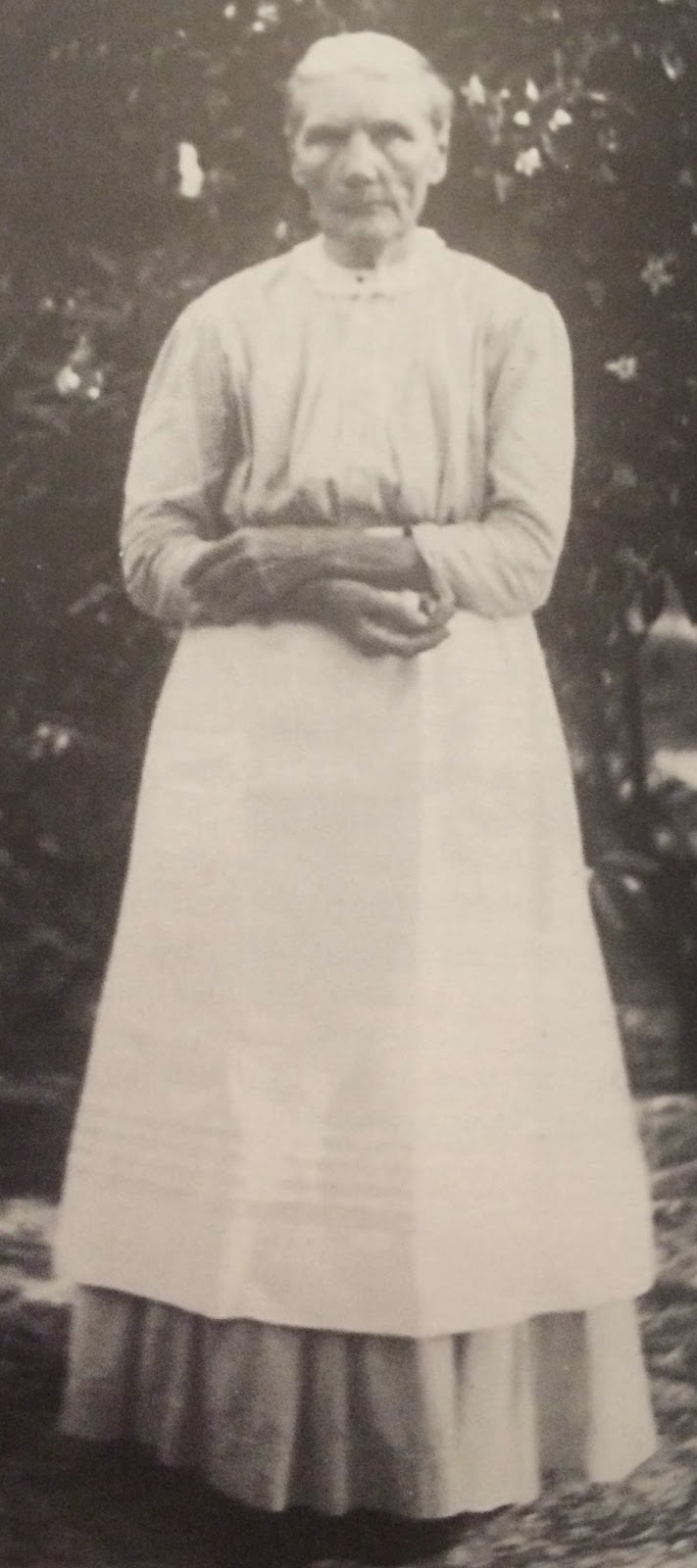
Her story in the fourth edition of Our Story of Orange City, Florida (Village Improvement Association, 2000) includes a picture of her in a no-frills garment, matched by a no-nonsense attitude. But even she put on a clean white apron to pose for the camera.

The Freeman family -- hotelkeepers  -- in another of the book's photos are ready for a different kind of business. The ruffles, tucks, bows, and pleats of the women's outfits speak of starched fabric and hours at the ironing board. Cinched waists tell of the corsets underneath. Every hair is in place - no easy task in our frizz-inducing humidity. The Freeman women are polished and professional as they wait to welcome guests. And the lone man in the photo also appears to be wearing crisp, clean clothing.

Family business activity was acceptable for 19th century women, particularly when based at home. Ladies who went out to work often faced discrimination, low pay and social disapproval. But you wouldn't guess it from a mid-1890s photo of the "women's editors" of the Orange City Times, an early newspaper. 

The editors smirk and smile for the camera. Their attire resembles that of the hotelkeepers in style. But the dresses aren't as starched. Wrinkles can be detected. And the hats are positively frightful. Perhaps they were the height of fashion. Or maybe they hid the frizzy tresses of a crew too busy breaking barriers to style their hair.

End note: You can visit the historic Thursby House at Blue Spring State Park.


19th century photo of family on porch
The Freeman family is poised and professional as they
 wait to greet guests at their hotel. The West Volusia
Historical Society photo is on page 22 of
Our Story of Orange City, Florida.


Monday, March 30, 2015

Florida as mission territory

Head-and-shoulders image of Fr. Patrick Bresnahan from his 1937 memoir
This image of Fr. Patrick Bresnahan
is from his memoir of mission work,
Seeing Florida With a Priest

While researching an early 1880s Catholic colony near Sanford, I found a fascinating book by Father Patrick J. Bresnahan on the excellent Central Florida Memory website. The 1937 Seeing Florida With a Priest recounts his journeys through Florida mission territory in the first decade of the 1900s. What's doubly interesting is that Fr. Bresnahan afterward became the first resident priest at All Souls Catholic Church in Sanford. That church's roots are in the early colony, whose history I'm exploring. Nice circle.

The dichotomy between ecumenism and religious prejudice in frontier Florida continues to intrigue me, and is found aplenty in the 97-page book and elsewhere. At the Sanford church and elsewhere in Florida, local non-Catholics often supported the building of Catholic churches. That seemed especially true in the 1880s. 

Meanwhile, Fr. Bresnahan writes of his first mission in Madison, Fla., in 1904, that "bigotry and prejudice were then rampant in that pretty town" (page 14).  One man who secretly attended mission services was regularly accused of being Catholic by his neighbors, because he tried to dispel misconceptions.

By the time a church building was under construction in Madison in 1907, "all the Catholics contributed generously, and some non-Catholics" (page 15). But all was not completely well. On the same page, Fr. Bresnahan tells how the sheriff threatened to arrest the Catholic church ladies for selling tickets for a giveaway of a patchwork quilt.

The raffle was part of a fundraising bazaar and supper. The town marshal came to the rescue, the publicity generated attention and the gala raised $400. My go-to inflation calculator website doesn't go back to 1907, but were that $400 raised in 1913, it would be the equivalent of $9,483 in 2015 dollars.

Once the church was built, non-Catholics converged to help form a robust choir for a two-week mission. "I left Madison with a feeling that I had done something to remove prejudice" (page 16), writes Fr. Bresnahan humbly. Soon after, he was in Tallahassee, where he found little bigotry despite the occasional "vomitings  of 'cheap' politicians" (page 18).

The above is just a sampling of what can be found in this valuable memoir, which was published by Economy Print Shop in Zephyrhills. I've not yet finished reading the book, but can't end this blog post without mentioning Fr. Bresnahan's encounters with Florida Crackers in Sopchoppy, "which is real country and 'cracker' village" (page 23). His experience bears quoting, because it corrects cultural history that, at times, still depicts pioneer Florida Crackers as backwoods bigots.

"The great interest exhibited during the mission was remarkable; it was conducted in the public school building. The natives, all 'crackers', vied with one another, unlike any other place, in giving me hospitality; and, they went so far as to get up parties for my entertainment, even though many had never seen a priest before. Moreover, they all seemed glad to find out what they had heard concerning priests hitherto were 'lies'." (page 23)

Ignorant backwoods folk? Hardly. The Crackers exhibited a genuine human dignity that contrasts starkly to the antics of some of the era's movers and shakers. There's a lesson in that.